
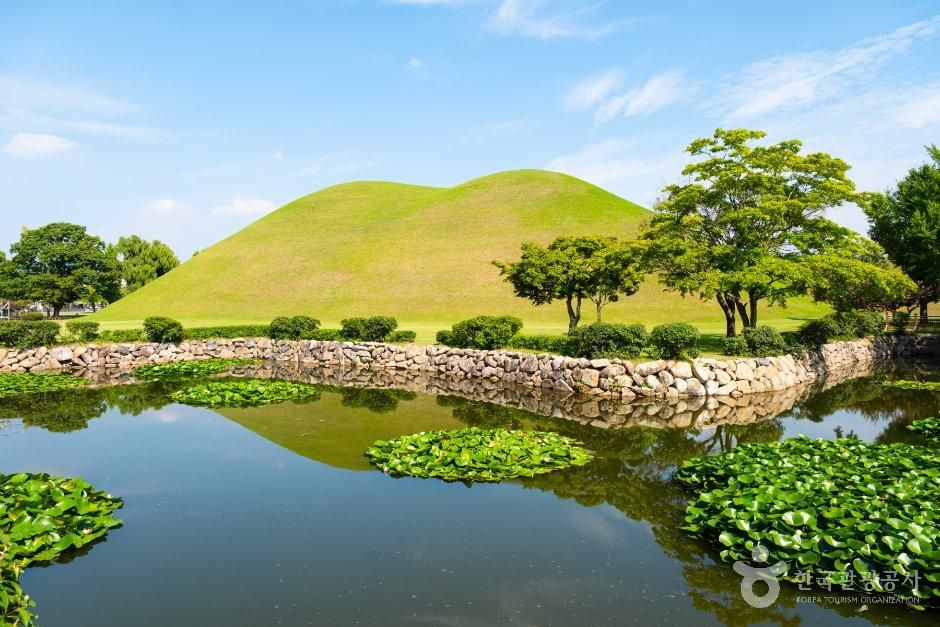
Daereungwon is the most walkable area of the Silla tombs in Nodong-dong and Hwangnam-dong, Gyeongju; entry is free, and only Cheonmachong charges separately (adults 3,000 won). According to the Korea Tourism Organization, the main gate opens 9:00 to 22:00 (last entry 21:30), and the rear gate and Cheonmachong 9:00 to 21:30, every day of the year. The commentary leads you past the bamboo-leaf soldiers legend of King Michu's tomb and Hwangnamdaechong, the largest tomb in Korea. Knowing the naming rule, neung when the occupant is known and chong when not, changes how you see them. Parking and toilets are available, and you can leave by the path behind Hwangnamdaechong.
- Location: Hwangnam-dong area, Gyeongju, Gyeongsangbuk-do
- Daereungwon admission: Free
- Cheonmachong admission: Adults 3,000 won; youth and military 2,000 won; children 1,000 won
- Hours: Main gate 9:00 to 22:00 (last entry 21:30); rear gate and Cheonmachong 9:00 to 21:30
- Closed: Open all year
- Inquiries: +82-54-771-8650
What is Daereungwon?
It is the name of a Silla tomb area in Nodong-dong and Hwangnam-dong, made up of the Nodong-dong, Noseo-ri, Hwangnam-dong, Hwango-dong and Inwang-dong tomb groups. Nodong-dong has Bonghwangdae, Sikrichong and Geumnyeongchong; Bonghwangdae, 230 m round at the base, 82 m across and 22 m high, is the largest stone-mound wooden-chamber tomb after Hwangnamdaechong. Noseo-ri has 14 tombs large and small on a broad plain, and Hwangnam-dong 30 round earthen mounds. Hwango-dong's mounds are badly damaged, with about 10 identifiable, thought to be 4th- to 5th-century royal or aristocratic stone-mound tombs. Inwang-dong is the easternmost group on the central Gyeongju plain, where 13 mounds were recorded during the Japanese occupation. Inside Daereungwon are the tomb attributed to King Michu, Cheonmachong and Hwangnamdaechong.
Hours and admission
| Category | Individual | Group |
|---|---|---|
| Daereungwon | Free | Free |
| Cheonmachong adults | 3,000 won | 2,400 won |
| Cheonmachong youth and military | 2,000 won | 1,600 won |
| Cheonmachong children | 1,000 won | 800 won |
National merit recipients and their spouses, registered disabled people, war veterans and holders of the 18 May democracy merit card, among others, get in free; call +82-54-771-8650 for details. The inside of the tomb is covered in the Cheonmachong guide. At the end of the walk, continue to Cheomseongdae and Donggung Palace and Wolji Pond.
Neung, chong and myo: how are tombs named?
The commentary dates the tombs to the 4th to early 6th century, as Silla royal power grew; occupants are uncertain, so they can't be called kings' tombs outright, though many are seen as royal given the politics of the time. The rule: when it is certain which king lies there, it is a neung with his name, like King Michu's tomb; when finds are valuable but the occupant unknown, a chong, like Cheonmachong; tombs of aristocrats and below are myo, like the tomb of Kim Yu-sin. Besides Cheonmachong, King Michu's tomb and Hwangnamdaechong, 37 other tombs are gathered here; the commentary calls tombs storehouses of knowledge about daily life that books can't give.
The legend of King Michu’s tomb
King Michu was Silla's first king of the Kim clan; the commentary says he repelled Baekje and promoted farming, and was loved as a wise ruler after death. The name Daereungwon comes from the record that he was buried in a great tomb (daereung). In the legend, when a neighbouring state invaded under King Yurye and Silla was in danger, soldiers with bamboo leaves in their helmets appeared and drove off the enemy, then vanished; countless bamboo leaves were found piled before King Michu's tomb. Believing the bamboo-leaf army came from his tomb, people called it Jukhyeolleung or Jungneung.
Why is Hwangnamdaechong gourd-shaped?
It is two joined mounds; because a stone-mound wooden-chamber tomb could not be reopened, the second was built against the first. Hwangnamdaechong is the largest tomb in Daereungwon and in Korea, also called a gourd-shaped tomb. A man's bones were found in the south mound and a woman's belt inscribed "Buindae" in the north, so it is thought to be a couple's tomb; the north mound held a gold crown, necklaces, bracelets and jade, and the south a gilt-bronze crown and weapons, so the north is seen as the queen's and the south the king's. Fragments of a girl of about 15 found with the man in the south mound confirmed retainer burial in Silla, previously known only from a record that it was banned after King Jijeung. On the way out, the path behind Hwangnamdaechong passes unnamed tombs.
- The main gate is open until 22:00 and the rear gate and Cheonmachong until 21:30; check your entrance in the evening.
- Daereungwon is free; only the inside of Cheonmachong charges.
- Leave by the path behind Hwangnamdaechong to see the unnamed tombs.
- Work out walking time to Cheomseongdae and Donggung Palace and Wolji Pond.
Who is it for?
- Walkers: the tourist information describes a dreamlike scene of mounds rising like ridgelines.
- Evening visitors: the main gate is open until 22:00.
- Artefact fans: Cheonmachong is the only tomb open inside.
See the Gyeongju guide for more.
FAQ
How much is admission?
Daereungwon is free; Cheonmachong is 3,000 won for adults, 2,000 won for youth and military and 1,000 won for children.
How late is it open?
Main gate 9:00 to 22:00 (last entry 21:30); rear gate and Cheonmachong 9:00 to 21:30. Open every day.
Where does the name come from?
From the record that King Michu was buried in a great tomb (daereung), according to the commentary.
Why are two mounds joined at Hwangnamdaechong?
A stone-mound wooden-chamber tomb could not be reopened, so a second tomb was built right next to the first.
Sources
- Korean-language tourist information (Gyeongju Daereungwon area, Cheonmachong, hours, admission) · Korea Tourism Organization TourAPI · accessed 2026-10-23
- Tourism storytelling commentary (Daereungwon, King Michu’s tomb, Hwangnamdaechong) · Korea Tourism Organization storytelling database · accessed 2026-10-23
Fees, hours and programmes can change, so check the latest information before you visit.
Information was checked against the official sources listed above. Opening hours, fees and fares can change; please confirm with the venue or operator before you visit.