
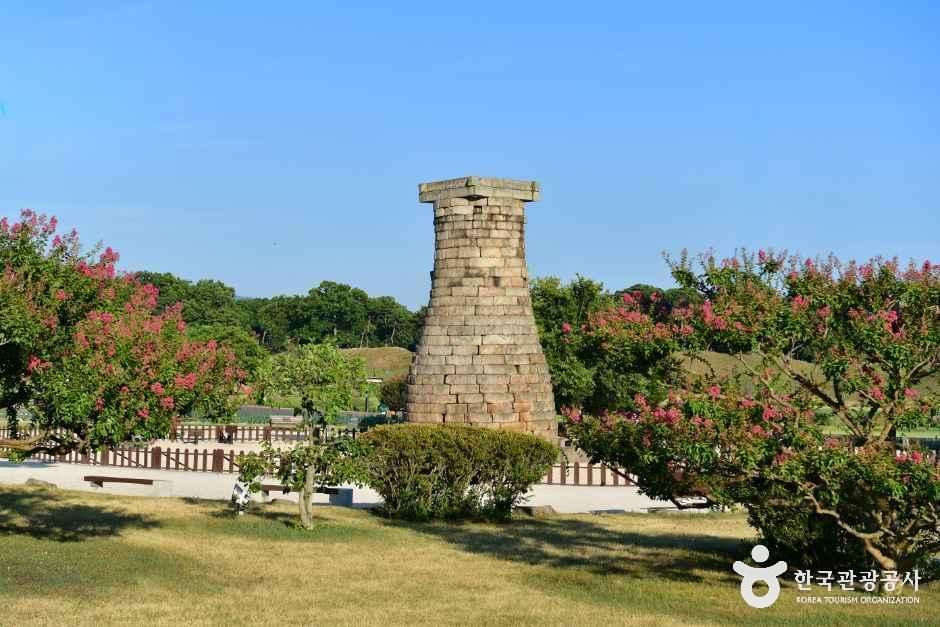
Cheomseongdae is an astronomical observatory thought to have been built under Queen Seondeok of Silla, and you can see it up close in Gyeongju for free. The Korea Tourism Organization says it is known as the oldest observatory in the East, about 9 m tall. It opens 9:00 to 22:00 in summer and 9:00 to 21:00 in winter, every day of the year, with cultural tourism guides available. The commentary starts with its 362 stones and introduces views that it was also a gnomon (sundial), Mount Sumeru or a cosmic well. Its site next to Wolseong, where the palace stood, made it easy to report observations to the king quickly.
- Location: 140-25 Cheomseong-ro, Gyeongju, Gyeongsangbuk-do
- Admission: Free
- Hours: Summer 9:00 to 22:00; winter 9:00 to 21:00
- Closed: Open all year
- Guides: Cultural tourism guides
- Inquiries: Singyeongju Station tourist information centre +82-54-771-1336
What kind of structure is it?
Thought to date from the reign of Queen Seondeok (632 to 647), it is about 9 m tall with a 27-course cylinder. A bottle-shaped cylinder of fan-shaped stones stands on a square base, topped with stones laid in the shape of the character 井 (well). Below the south-east window the interior is filled with rubble; above it to the top it is hollow. The commentary reads it as a circle for round heaven and a square for flat earth. The Dongguk Yeoji Seungnam records people climbing in and out of the square window to watch the stars, and grooves thought to be from a ladder have been found inside; the lower part was filled with earth and gravel as a foundation.
Hours and admission
| Item | Details |
|---|---|
| Admission | Free |
| Summer | 9:00 to 22:00 |
| Winter | 9:00 to 21:00 |
| Closed | Open all year |
| Guides | Cultural tourism guides |
| Inquiries | Singyeongju Station tourist information centre +82-54-771-1336 |
Parking and toilets are available. Because it is open into the evening, it is easy to see after a walk round Daereungwon, and to continue to Donggung Palace and Wolji Pond and other sites in the Gyeongju guide. The tourist information says flowers and plants bloom here in every season, drawing many visitors.
What do the 362 stones mean?
The commentary says it is built of 362 stones, the number of days in a lunar year, and that its 12 base stones represent the 12 months, so Silla people may have seen it as a calendar; this is a possibility, not a conclusion. The site was chosen next to Wolseong, where the king lived, to report changes in the sky quickly. After it was built, the Samguk Sagi records eclipses, comets and unusual weather more often and very accurately.
Was it really an observatory?
Theories range from a star observatory to an altar for heavenly rites. One is a gnomon to measure the sun's shadow, marking equinoxes and solstices for farming; the narrow space would have been hard to climb daily or to house instruments like an armillary sphere, so it may have acted as a sundial needle. Another is a religious monument: Queen Seondeok asked to be buried in Trayastrimsha heaven, which in Buddhist cosmology sits atop Mount Sumeru, whose shape it resembles. A third is a cosmic well: Silla people saw wells as passages between the sacred and earthly worlds, and the founder Hyeokgeose and his queen Alyeong were said to be born from wells. Whatever the view, the commentary concludes, it is an original heritage uniting fine building and science.
- Note closing at 22:00 in summer and 21:00 in winter for evening plans.
- Ask on site or at the tourist information centre for a guide.
- Plan your order with Daereungwon and Donggung Palace and Wolji Pond.
- Read about the 362 stones and 12 base stones in advance.
Who is it for?
- Evening walkers: open until 22:00 in summer.
- Science and history fans: observatory, calendar and sundial theories.
- Pairing with Daereungwon: Daereungwon is within walking distance.
FAQ
How much is admission?
It is free.
How late is it open?
9:00 to 22:00 in summer and 9:00 to 21:00 in winter, every day.
When was it built?
It is thought to date from the reign of Queen Seondeok (632 to 647).
Was it really an observatory?
It is known as one, but the commentary also introduces gnomon, religious monument and cosmic well theories.
Sources
- Korean-language tourist information (Gyeongju Cheomseongdae, hours, admission) · Korea Tourism Organization TourAPI · accessed 2026-10-23
- Tourism storytelling commentary (Cheomseongdae and ancient astronomy) · Korea Tourism Organization storytelling database · accessed 2026-10-23
Fees, hours and programmes can change, so check the latest information before you visit.
Information was checked against the official sources listed above. Opening hours, fees and fares can change; please confirm with the venue or operator before you visit.