
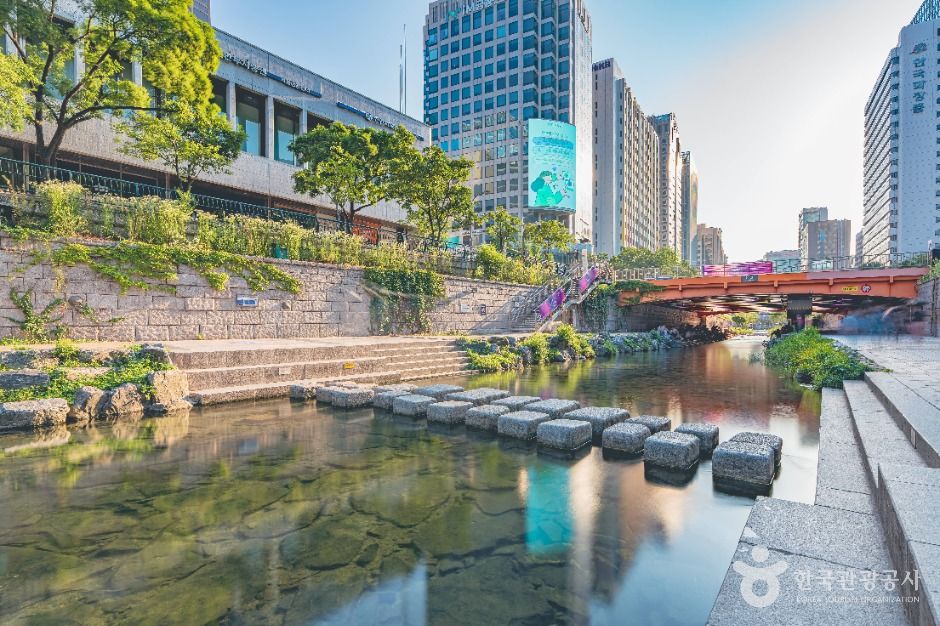
Cheonggye Plaza is the square built where Cheonggyecheon stream begins, on Sejong-ro in Seoul. The Korea Tourism Organization describes it as one of Seoul's signature sights, with a nature-friendly environment, loved by residents and international visitors; there is no admission fee, and it is always open, all year. Highlights include a three-color lighted fountain, a two-tier waterfall, Palseokdam (made with stones brought from all over the country) and a 1/100 scale miniature of the whole of Cheonggyecheon. The commentary says that going down from the square to Cheonggyecheon leads you into Joseon-era stories at Gwangtonggyo Bridge, the mural of King Jeongjo's royal procession, the Supyogyo Bridge site and Ogansugyo Bridge. Parking is not available, so use public transport.
- Location: Taepyeongno 1-ga, Jung-gu, Seoul
- Admission: Free
- Hours: Always open, all year
- Parking: Not available
- About Cheonggyecheon: Total length 10.84 km, restored section 5.84 km, 22 bridges (Korea Tourism Organization information on Cheonggyecheon)
- Inquiries: +82-2-2290-7111
What is Cheonggye Plaza?
The commentary says today's Cheonggye Plaza was created along with the restoration of Cheonggyecheon. On one side of the square stands Spring, a blue spiral sculpture. The commentary introduces it as a work by American artists Claes Oldenburg and Coosje van Bruggen, inspired by the beauty they found in Korean ceramics, hanbok and the full moon, to express Seoul's leap forward. Inside the sculpture, water falls to the ground and flows into the miniature Cheonggyecheon channel.
Going down from the square to Cheonggyecheon, you reach the fountain and the two-tier waterfall. According to the Korea Tourism Organization, water drops about 4 m from the waterfall, and on either side lies Palseokdam, made with eight kinds of stone brought from all over the country. At night the lights and water come together, and many people visit after dark too. Cultural events and festivals for residents are said to be held in the square throughout the year, but the schedule changes every year, so check on site.
What is Cheonggyecheon, and how was it restored?
According to Korea Tourism Organization information on Cheonggyecheon, it is a 10.84 km stream that divides Jongno-gu and Jung-gu. From July 2003 to September 2005, the 5.84 km section that had been covered by Cheonggyecheon-ro and around Samil-ro was restored, and 22 new bridges were built to turn it into a place of rest for residents. The same information notes that access may be closed in rain for safety.
The history of Cheonggyecheon as told in the commentary is this: a small everyday stream at the founding of Joseon took its present shape through improvement works under Kings Sejong and Yeongjo; from the Japanese colonial period to the 1960s it was gradually covered over; and in the 1970s the Cheonggye Overpass was built. From 2003, the concrete was removed and it was brought back to life as a flowing stream.
| Period | The story of Cheonggyecheon (per the commentary) |
|---|---|
| Early Joseon | Began as a small everyday stream |
| Kings Sejong and Yeongjo | Improvement works gave the channel its present shape |
| Japanese colonial period to the 1960s | The stream was gradually covered over |
| 1970s | The Cheonggye Overpass was built |
| From 2003 | The cover was removed and the stream restored |
What stories do the bridges of Cheonggyecheon tell?
The commentary introduces Gwangtonggyo as the signature bridge of the Joseon period, with a history of some 600 years. It was buried when Cheonggyecheon was covered and has been restored, moving from its original site at Gwanggyo to its current location. The patterned guardian stones under the bridge are in a style seen in queens' tombs from late Goryeo to early Joseon, and the story goes that when King Taejong rebuilt the earthen bridge after a flood destroyed it, he used stones from the tomb of Queen Sindeok. The bridge lay on the route of royal processions and foreign envoys, and folk games such as bridge-treading were held there on the first full moon of the lunar year.
The commentary introduces the mural of King Jeongjo's royal procession as a ceramic mural 192 m long made of 4,960 tiles. It depicts Jeongjo's procession to Hwaseong Fortress in Suwon for the 60th-birthday banquet of his mother, Lady Hyegyeong, and to visit the tomb of his father, Crown Prince Sado; following the custom of not portraying the king's face, only Jeongjo's horse is shown. At the Supyogyo Bridge site you can hear about the supyo, a water-level gauge made by Jang Yeong-sil, and at Ogansugyo about the Ogansumun floodgate under the city wall at Heunginjimun and the large-scale dredging works under King Yeongjo.
The north end of the square leads to our Gwanghwamun Square guide; add the palaces with our Gyeongbokgung guide and Jongmyo guide to complete a day's route.
Check before you visit Cheonggye Plaza
- On rainy days, first check whether access to Cheonggyecheon is closed.
- To see the evening lights, time your visit to sunset.
- Parking is not available, so travel by subway or bus.
- Ask about event schedules at +82-2-2290-7111.
What kind of trip is Cheonggye Plaza good for?
Good for:
- Evening walks: the night scene of three-color lighting and the waterfall.
- History walks: the stories of Gwangtonggyo, Supyogyo and Ogansugyo.
- Linking downtown sights: Gwanghwamun Square and Gyeongbokgung are close.
- A free stop: no admission fee and always open.
Frequently asked questions
How much is admission to Cheonggye Plaza?
It is free, always open and open all year.
Is there parking at Cheonggye Plaza?
Korea Tourism Organization information says parking is not available.
Can I go down to Cheonggyecheon in the rain?
Access may be closed in rain for safety reasons.
How long is Cheonggyecheon?
Its total length is 10.84 km, of which a 5.84 km section was restored from 2003 to 2005.
Sources
- Korean-language tourist information (Cheonggye Plaza, overview of and visitor information for Cheonggyecheon) · Korea Tourism Organization TourAPI · accessed 2026-10-23
- Tourism storytelling commentary (Cheonggye Plaza, Gwangtonggyo, the royal procession mural, Supyogyo site, Ogansugyo) · Korea Tourism Organization storytelling database · accessed 2026-10-23
Information was checked against the official sources listed above. Opening hours, fees and fares can change; please confirm with the venue or operator before you visit.