
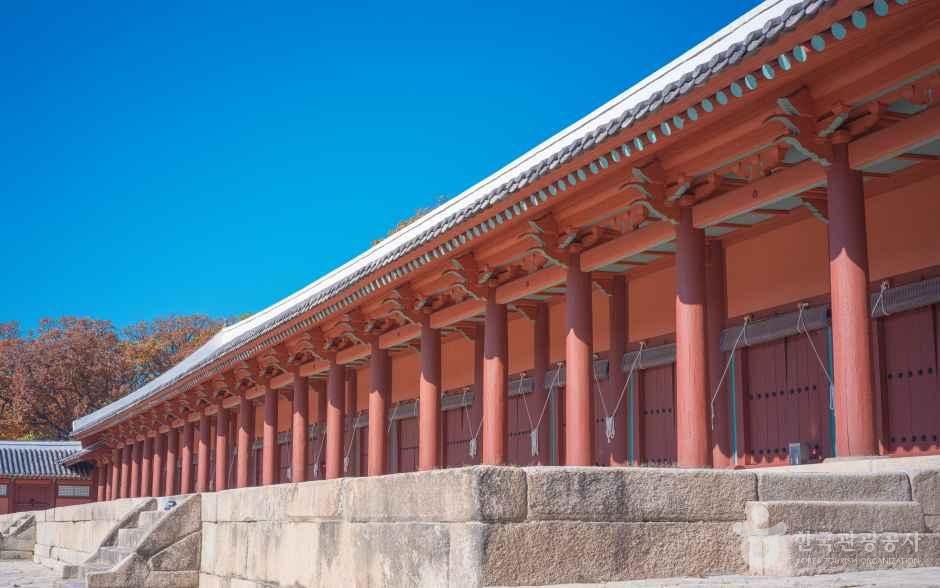
Jongmyo is the national shrine where the spirit tablets of the kings and queens of Joseon, and of the emperors and empresses of the Korean Empire, were enshrined and where ancestral rites were held. The Korea Tourism Organization says that after King Taejo made Hanyang the capital, he had Jongmyo built before the palace, and the commentary interprets it as a space where the founding ideals of filial piety and loyalty were practiced at the national level. Admission is ₩1,000, and it is closed every Tuesday. Hours vary by season: until 6 p.m. from February to May and September to October, 6:30 p.m. from June to August, and 5:30 p.m. from November to January. The buildings follow one another in the order you walk from the main gate to Jeongjeon, and the inside of the spirit chambers is not open to the public, so the information boards and recreated displays are the focus of a visit.
- Location: 157 Jong-ro, Jongno-gu, Seoul (Hunjeong-dong)
- Admission: ₩1,000
- Closed: Every Tuesday (if Tuesday is a public holiday, it opens and closes on the next weekday instead)
- Hours: February–May 9:00–18:00, June–August 9:00–18:30, September–October 9:00–18:00, November–January 9:00–17:30
- Last entry: 1 hour before closing
- Parking: Available, ₩400 per 5 minutes
- Inquiries: +82-2-765-0195
What is Jongmyo?
According to the Korea Tourism Organization, Jongmyo consists of Jeongjeon, the original building, Yeongnyeongjeon, a separate shrine, and other ancillary buildings. After its founding, Joseon built Jongmyo here following the rite of placing the royal ancestral shrine to the left of the palace and the altar of land and grain to the right; at first there was only the building that is now Jeongjeon. Later, under King Sejong, a separate shrine was built next to Jeongjeon and named Yeongnyeongjeon.
The commentary points out its scale at the Jongmyo information board: it is large enough to hold seven football pitches, and it reached its present form after many rounds of rebuilding since construction began. The Jongmyo royal ancestral rite was designated a Masterpiece of the Oral and Intangible Heritage of Humanity in 2001, making it a rare case of tangible and intangible heritage continuing in one place. The dismount stone (hamabi) at the entrance marked where everyone, regardless of rank, got off their horse to pay respect.
| Building | Purpose |
|---|---|
| Jeongjeon | The main building, enshrining the spirit tablets of successive kings and queens |
| Yeongnyeongjeon | A separate shrine for the tablets of kings and queens no longer kept in Jeongjeon |
| Jaegung | Where the king and crown prince stayed the day before a rite to purify themselves |
| Jeonsacheong | The building where food for the rites was prepared |
In what order do I walk from the main gate to Jeongjeon?
From the outer gate to the south spirit gate of Jeongjeon, the path has three lanes. According to the commentary, the middle lane is the path of the spirits and incense, used only by the ancestral spirits and the officiants carrying incense. Seen from Jeongjeon, the east lane is the king's path and the west lane is the crown prince's path. Walking to the right, you come to Mangmyoru in front of a pond. It was the office that guarded Jongmyo, and its name comes from the king looking toward the shrine from the pavilion and thinking of the nation.
The pond is square with a round island, symbolizing the harmony of heaven and earth, and one juniper tree grows on the island. The commentary notes that it has neither fish nor lotus, which distinguishes a shrine pond from a palace pond. Hyangdaecheong has Hyangcheong on the left facing Jipsacheong on the right; Hyangcheong stored the incense, ritual texts and offerings used in the rites, and today it serves as an education center with a recreated Jongmyo ritual table setting.
Jaegung has three buildings: the king stayed in Eojaesil in the middle and the crown prince in Seja Jaesil on the right, and they bathed and purified themselves in Eomogyokcheong on the left. Jeonsacheong is a set of buildings around a square courtyard; the stone mortar in the courtyard and the well (jejeong) beside it are traces of ritual preparations. The commentary says animals for sacrifice were inspected, and those that passed were raised in pens for 90 days until the day of the rite.
How do Jeongjeon and Yeongnyeongjeon differ?
According to the commentary, Jeongjeon is the largest and longest of Korea's old buildings. It has 19 chambers holding spirit tablets; following the custom of treating the west as the higher position, Taejo is at the far left, Sejong in the middle and Sunjong at the far right. The building, which originally had seven chambers, was extended in turn under Kings Myeongjong, Yeongjo and Heonjong to its present length. Although it is more than 100 m long, the column heights were varied so it looks level to the eye, and the doors were deliberately left slightly open to help ventilation.
Yeongnyeongjeon is smaller and more intimate than Jeongjeon. It was built to enshrine Taejo's four direct ancestors, and side bays were added as the number of tablets of kings and queens moved from Jeongjeon grew. The commentary notes that the deposed Yeonsangun and Gwanghaegun could not be enshrined at Jongmyo, while Danjong was reinstated after many years and enshrined at Yeongnyeongjeon. The inside of the chambers is not open to the public, so you picture it from the information boards and the recreations at Hyangdaecheong.
Opposite Jeongjeon are Gongsindang and Chilsadang. The commentary introduces Gongsindang as the shrine for the tablets of meritorious subjects who served the kings enshrined in Jeongjeon, and Chilsadang as the shrine for rites to seven deities believed in by ordinary people. If you plan to visit with Gyeongbokgung, read our Gyeongbokgung guide first to plan your route. Other palaces in the old capital continue in our Changdeokgung guide, and your whole Seoul itinerary in our Seoul guide.
What are the Jongmyo royal ancestral rite and its music?
The commentary introduces the Jongmyo royal ancestral rite (Jongmyo Jerye) as the largest and most important state ceremony among Joseon-period rites. The sequence is to burn incense and pour wine to welcome the ancestral spirits, read the ritual text, share the wine and meat offered on the altar, and finally burn the ritual text and offerings to send the spirits off. It barely survived through the Japanese colonial period, was restored from 1969 by the Jeonju Yi Royal Family Association, and is now held every year on the first Sunday of May.
Jongmyo Jeryeak, the ritual music, consists of eleven Botaepyeong pieces and eleven Jeongdaeeop pieces, combining instrumental music, song and dance. The commentary says King Sejong created jeonggan-bo, a notation recording pitch and rhythm on one score, to preserve this music. Ceremony dates and whether you can watch may change from year to year, so check before you visit. Whether visits are free-roaming or by timed guided tour is not in the Korea Tourism Organization information, so check on site.
Check before you visit Jongmyo
- Make sure your visit is not on a Tuesday.
- Work out the last entry time from the seasonal closing time.
- Ask about how visits work and whether booking is needed at +82-2-765-0195.
- If you want to watch the rite on the first Sunday of May, check the date separately.
- The chambers are not open, so include the recreated display at Hyangdaecheong in your plan.
What kind of trip is Jongmyo good for?
Good for:
- History lovers: see on site the difference between Jeongjeon and Yeongnyeongjeon, and concepts such as temple names and permanent enshrinement (bulcheonwi).
- Architecture: see the roof over 100 m long and the entasis columns from the front.
- Combining with palaces: link the spaces of the Joseon royal family with Gyeongbokgung and Changdeokgung.
- World Heritage visits: for travelers looking for a place with both World Cultural Heritage and Intangible Cultural Heritage of Humanity.
Frequently asked questions
How much is admission to Jongmyo?
₩1,000, according to Korea Tourism Organization information.
When is Jongmyo closed?
Every Tuesday. If Tuesday is a public holiday, it opens and closes on the first weekday after instead.
What are the opening hours?
9:00–18:00 from February to May and September to October, 9:00–18:30 from June to August, and 9:00–17:30 from November to January. Entry closes one hour before closing in each case.
Can I see inside the spirit chambers?
The commentary says the inside of the chambers is not open to the public. Instead you can see them through the information boards and the recreated display at Hyangdaecheong.
Sources
- Korean-language tourist information (Jongmyo visitor information and overview) · Korea Tourism Organization TourAPI · accessed 2026-10-23
- Tourism storytelling commentary (stories of each Jongmyo building, the Jongmyo royal ancestral rite (audio guide)) · Korea Tourism Organization storytelling database · accessed 2026-10-23
Information was checked against the official sources listed above. Opening hours, fees and fares can change; please confirm with the venue or operator before you visit.