
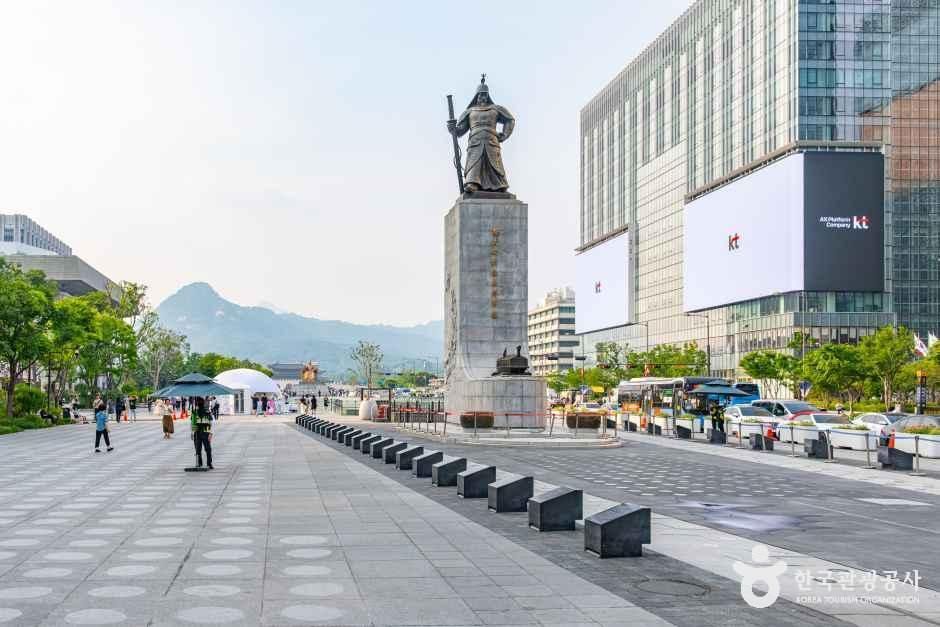
Gwanghwamun Square is a downtown Seoul square that runs from Gwanghwamun, the main gate of Gyeongbokgung, to Cheonggye Plaza; there is no admission fee, and it is always open, all year. The Korea Tourism Organization describes it as a space for experiencing history and culture that turned Sejong-ro from a car-centered road into a people-centered space and brought back the look of the old Yukjo Street (the street of the six ministries). At the entrance, the royal terrace (woldae) has been recreated and the haetae statues restored, and around Sejongno Park there are traces of Yukjo Street and a scale model. The Gwanghwamun Tourist Information Center can be reached at +82-2-735-8688; there are toilets, but parking is not available. According to the commentary, exhibition spaces on King Sejong and Admiral Yi Sun-sin lie beneath the square, so simply walking it lets you meet two eras.
- Location: 172 Sejong-daero, Jongno-gu, Seoul
- Admission: Free
- Hours: Always open, all year
- Opened: August 1, 2009 (per Korea Tourism Organization information)
- Parking: Not available
- Facilities: Toilets available
- Inquiries: Gwanghwamun Tourist Information Center +82-2-735-8688
What is Gwanghwamun Square?
The Korea Tourism Organization describes Gwanghwamun Square as the place where Sejong-ro, Seoul's central street with 600 years of history, was turned into a people-centered space. You can take in views of Gyeongbokgung and Bugaksan, and the old look of Yukjo Street has been brought back so visitors can experience history and culture. In the entrance section, a square restoring the history of Gwanghwamun, the royal terrace has been recreated and the haetae statues restored; in the section around Sejongno Park, traces of Yukjo Street and a scaled-down model have been placed.
The commentary describes the space as including a ten-lane reserve square, used as a road normally and as a square during large events. This wording reflects the layout at the time the commentary was written and may differ from the current layout, so check on site how each section is used.
What was this place in the Joseon period?
According to the commentary, when King Taejo (Yi Seong-gye) built Gyeongbokgung, he laid a straight road from Geunjeongjeon to Gwanghwamun so he could look after the people. The six ministries, which served as today's executive and judiciary, stood on both sides of the main road in front of Gwanghwamun, and the area in front of the gate was where Confucian scholars submitted petitions, making it a place where king and people communicated.
The commentary also covers its ordeals from the Japanese colonial period onward. When the Japanese Government-General building went up inside Gyeongbokgung, Gwanghwamun was moved next to Geonchunmun, the east gate; its wooden upper part burned in the Korean War; and in 1968 it was repaired in concrete but did not regain its former dignity. In 2010, Gwanghwamun was restored to its original position in its Joseon-period form, and the square regained its meaning too. Continue inside the palace with our Gyeongbokgung guide.
| Period | What happened around Gwanghwamun (per the commentary) |
|---|---|
| Early Joseon | A straight road was laid from Geunjeongjeon to Gwanghwamun, with the six ministries on both sides |
| Japanese colonial period | The Government-General building went up inside Gyeongbokgung, and Gwanghwamun was moved next to Geonchunmun |
| Korean War | The upper part of Gwanghwamun burned down |
| 1968 | Repaired in concrete |
| 2010 | Restored to its original position in its Joseon-period form |
What can I see in the square?
The commentary names the statues of Admiral Yi Sun-sin and King Sejong as the first things you meet in the square. Going down the stairs behind the statue of King Sejong, you find The Story of King Sejong, an exhibition on his life and achievements, with The Story of Admiral Yi Sun-sin opposite. The Story of King Sejong is said to have a touchscreen program for exploring Hangeul, a sundial activity and a corner where you play the Jongmyo Jeryeak ritual music on 3D devices; The Story of Admiral Yi Sun-sin has a 4D experience space, a corner where you experience the inside of a turtle ship, and games of rowing and assembling a mini turtle ship. Opening hours and fees for the exhibitions are not in the Korea Tourism Organization information, so check on site.
The original soil layers of Yukjo Street discovered during construction of the square, and the History Waterway, where Korean history is carved on stone slabs above the channels on both sides, are also highlights. Near the square is the National Museum of Korean Contemporary History, introduced in the same set of commentaries. The commentary describes it as a museum of modern and contemporary history from the opening of the ports in late Joseon to today, with permanent galleries on the 3rd to 5th floors and a special exhibition gallery on the 1st floor.
The south end of the square leads to our Cheonggye Plaza guide. To combine it with palace visits, see our Changdeokgung guide too.
Check before you visit Gwanghwamun Square
- Check the hours and fees of the underground exhibitions before you visit.
- Check on site which sections are open and whether any are closed for events.
- Parking is not available, so plan to use public transport.
- If you are also visiting Gyeongbokgung, check the palace closing day separately.
What kind of trip is Gwanghwamun Square good for?
Good for:
- First-time visitors to Seoul: Gyeongbokgung, Gwanghwamun and Cheonggye Plaza link in one route.
- Families with children: the hands-on corners of The Story of King Sejong and The Story of Admiral Yi Sun-sin.
- History walks: see the traces of Yukjo Street, the History Waterway and the original soil layers.
- Short itineraries: no admission fee and always open, so any time works.
Frequently asked questions
How much is admission to Gwanghwamun Square?
It is free, always open and open all year.
Is there parking at Gwanghwamun Square?
Korea Tourism Organization information says parking is not available, so use public transport.
What is the phone number of the Gwanghwamun Tourist Information Center?
+82-2-735-8688.
When did Gwanghwamun Square open?
Korea Tourism Organization information gives the opening date as August 1, 2009, and notes that it has since been redesigned.
Sources
- Korean-language tourist information (overview of and visitor information for Gwanghwamun Square) · Korea Tourism Organization TourAPI · accessed 2026-10-23
- Tourism storytelling commentary (Gwanghwamun Square, National Museum of Korean Contemporary History) · Korea Tourism Organization storytelling database · accessed 2026-10-23
Information was checked against the official sources listed above. Opening hours, fees and fares can change; please confirm with the venue or operator before you visit.