
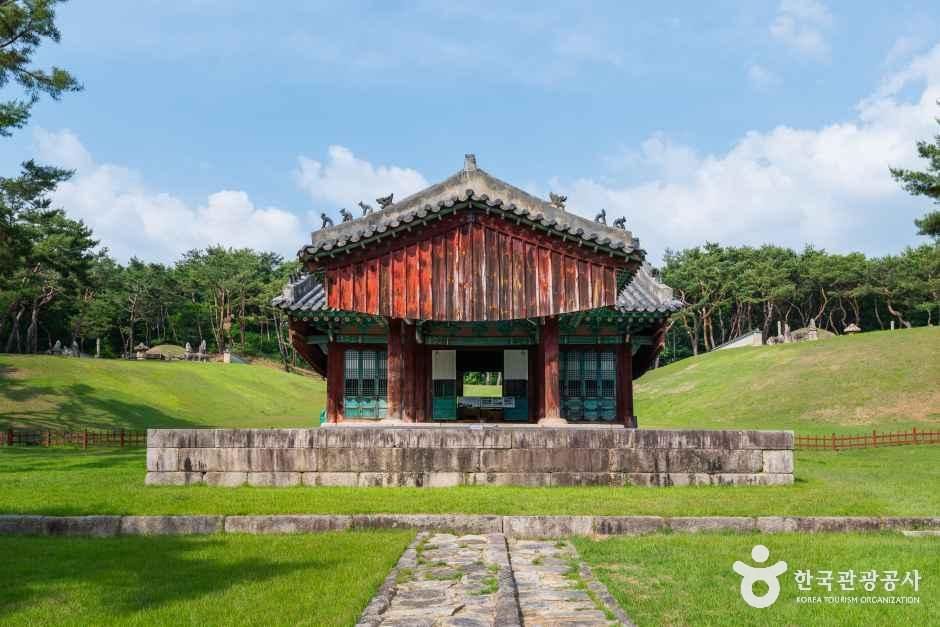
Seooreung in Goyang, Gyeonggi-do, is a group of Joseon royal tombs; the name means "five tombs to the west": Gyeongneung, Changneung, Ingneung, Myeongneung and Hongneung. The Korea Tourism Organization calls it the largest royal tomb group after Donggureung in Guri. Admission is 1,000 won (groups 800 won, local residents 500 won), free for ages 24 and under and 65 and over. It is closed on Mondays; hours vary by season and may be shortened. The commentary presents it as King Sukjong's family cemetery, covering Myeongneung's simple burial mounds and three-way path, Hongneung's empty place and the stories of royal women.
- Location: 334-32 Seooreung-ro, Deogyang-gu, Goyang, Gyeonggi-do
- Admission: Individual 1,000 won; groups (10+) 800 won; local residents 500 won
- Free: Ages 24 and under, 65 and over
- Closed: Mondays (open if a public holiday, then closed the next weekday)
- Hours: February to May and September to October 7:00 to 18:00; June to August 7:00 to 18:30; November to January 7:00 to 17:30
- Parking: Available
- Inquiries: +82-2-359-0090
What is Seooreung?
In 1457 Gyeongneung, the tomb of Crown Prince Uigyeong, eldest son of King Sejo, came first; in 1470 Changneung of King Yejong became the first royal (king's) tomb here. Then came Sunchangwon of Crown Prince Sunhoe, Ingneung of Queen Ingyeong, Myeongneung of King Sukjong and Hongneung of Queen Jeongseong. Seooreung's Gyeongneung is the tomb of the posthumous King Deokjong and Queen Sohye, different from Gyeongneung (Heonjong) at Donggureung. The commentary begins with King Sejo, grieving for his son, choosing the site himself; King Yejong took the throne at 19 and died 14 months later, and though Changneung came after Gyeongneung, it was the first king's tomb here.
| Tomb | Occupants | Story in the commentary |
|---|---|---|
| Gyeongneung | Crown Prince Uigyeong (posthumous King Deokjong), Queen Sohye | The prince’s illness; mounds with swapped positions |
| Changneung | King Yejong, Empress Ansun | Tomb of a short-lived king |
| Ingneung | Queen Ingyeong | King Sukjong’s first queen, who died of smallpox |
| Myeongneung | King Sukjong, Queens Inhyeon and Inwon | Simple mounds, three-way path |
| Hongneung | Queen Jeongseong | King Yeongjo left his own place empty |
What to see at Myeongneung
The commentary says Sukjong, though fiery, lived frugally and ordered royal tombs to be built simply, so Myeongneung is cited as a model of reduced labour, cost, grave goods and stonework. The civil-official statues between the mounds of Sukjong and Queen Inhyeon are 169 cm, the height of a real person then, the smallest among Joseon royal tombs but very lifelike. The stone lantern changed from octagonal to square, and the three mounds are linked only by railing stones, without screen stones.
Usually a royal tomb has two paths, but here, besides the spirit path for gods and officiants and the king's path, there is a third path beside the king's for officials, to distinguish the ways of officials, king and gods. The commentary also tells at length of the three changes of government under Sukjong and of Queen Inhyeon, Jang Hui-bin and Royal Consort Suk of the Choe clan.
Gyeongneung, Ingneung and Hongneung
Crown Prince Uigyeong was gentle and frail compared with his father Sejo and died of an unknown illness; the dramatised dialogue mentions a curse by Queen Hyeondeok, which should be taken as legend. The shrine has two staircases; the one carved with clouds is for spirits, so officiants use the other. Ingneung, of Sukjong's first queen Ingyeong, stands alone a little way from Myeongneung. Hongneung is the tomb of Queen Jeongseong, King Yeongjo's wife: Yeongjo had the west side, to her right, left empty for himself and the stone figures made in pairs. Leaving the king's place empty to the right of the queen is called uheoje, and Hongneung is the only Joseon example. After Yeongjo died, King Jeongjo chose a better site and Yeongjo was buried with Queen Jeongsun at Wolleung in Guri; see Donggureung. For Seoul, see Seonjeongneung; for the bigger picture, the Gyeonggi guide.
- Check Monday closures and the public-holiday rule.
- Hours may be shortened; check on +82-2-359-0090 before you go.
- Plan your arrival from the last entry time.
- If you qualify for free entry (24 and under, 65 and over), ask on site how ID is checked.
Who is it for?
- History stories: royal women of the Sukjong and Yeongjo eras.
- Tomb structure: the three-way path and shrine staircases.
- Comparing with Donggureung: differences in scale and form.
- Family outings: low admission and parking.
FAQ
How much is admission?
Individual 1,000 won, groups of 10+ 800 won, local residents 500 won; free for ages 24 and under and 65 and over.
When is it closed?
Every Monday. If Monday is a public holiday, it opens and closes the next weekday.
Which tombs are there?
Gyeongneung, Changneung, Ingneung, Myeongneung and Hongneung.
Do the hours change?
The Korea Tourism Organization notes that hours may be shortened or adjusted.
Sources
- Korean-language tourist information (Seooreung overview, visitor information, admission) · Korea Tourism Organization TourAPI · accessed 2026-10-23
- Tourism storytelling commentary (Seooreung information board, Gyeongneung, Changneung, Ingneung, Myeongneung, Hongneung) · Korea Tourism Organization storytelling database · accessed 2026-10-23
Fees, hours and programmes can change, so check the latest information before you visit.
Information was checked against the official sources listed above. Opening hours, fees and fares can change; please confirm with the venue or operator before you visit.