
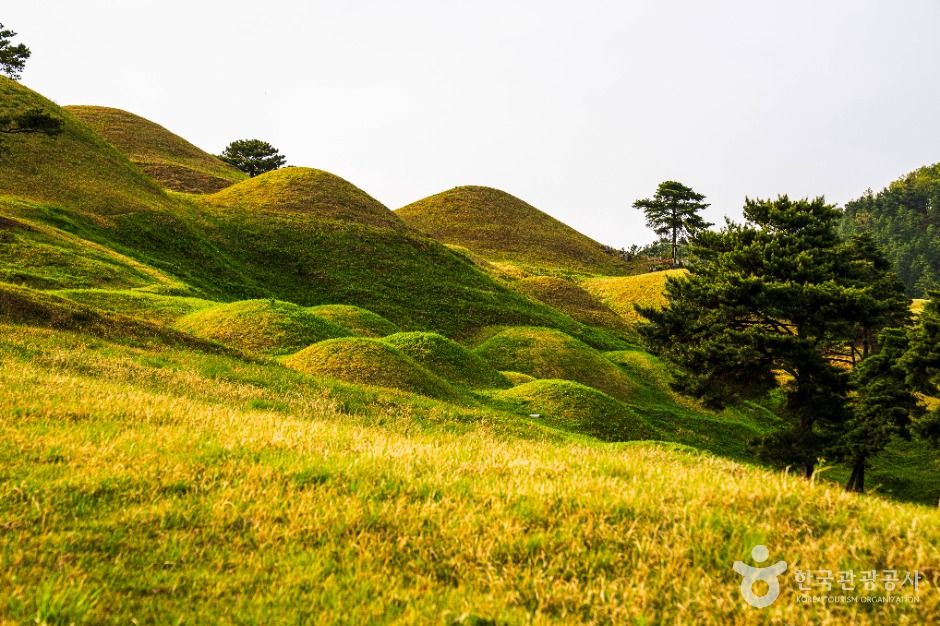
The Jisandong Ancient Tombs in Goryeong are a Historic Site where the tombs of Daegaya's ruling class run along a ridge. The Korea Tourism Organization says that since the first excavation in 1906 about 700 tombs, large and small, have been excavated, thought to be mostly elite tombs built between the 4th and 6th centuries. Admission and parking are free, and the site is always open, every day of the year. Inquiries: Goryeong-gun Office Cultural Heritage Division, +82-54-950-6323. The commentary starts with the full-size reconstruction of Tomb 44 in the Royal Tomb Exhibition Hall next to the museum, then follows the trail past Tombs 32 to 35, 44 and 45, and Tomb 47, called the tomb of King Geumnim.
- Location: Jisan-ri, Daegaya-eup, Goryeong-gun, Gyeongsangbuk-do
- Admission: Free
- Hours: Always open, all year
- Parking: Available, free
- Scale: About 700 tombs excavated (Korea Tourism Organization data)
- Inquiries: Goryeong-gun Office Cultural Heritage Division +82-54-950-6323
What are the Jisandong Ancient Tombs?
All the tombs are round earthen mounds, classed as large, medium or small by size. Large mounds cluster at the top of the ridge, medium ones below the middle, and small ones around or beneath them. Inside are stone-cist, stone-lined pit and stone-chamber tombs. Goryeong was the centre of Daegaya, and the tombs line the ridge that wraps Daegaya-eup like a folding screen. The commentary calls it the place where 520 years of Daegaya history are revealed through tombs: Daegaya left no written history and long went unnoticed, and these tombs speak for the lost kingdom.
| Item | Details (Korea Tourism Organization data) |
|---|---|
| First excavation | 1906 |
| Scale | About 700 tombs, large and small |
| Date | Mostly 4th to 6th centuries (estimated) |
| Mound shape | All round earthen mounds |
| Inner structure | Stone-cist, stone-lined pit and stone-chamber tombs |
The story of Tomb 44
The Royal Tomb Exhibition Hall reconstructs the interior of Tomb 44 at close to full size, 27 m across and 6 m high. It had been looted before excavation, but many artefacts remained and are displayed. From a viewing deck you look down on the main stone chamber, the chamber for grave goods and the many retainer burial chambers.
The commentary says Tomb 44 dates from the late 5th century and surpasses other royal-class Gaya tombs of the time in scale and form. A guide recalls that retainer burial was known only from records until more than 40 retainers were confirmed here. Fatal injuries on some remains suggest they were not buried willingly, while gold earrings show that not only low-status people were buried. These are the commentary's interpretations and should be read alongside scholarly views.
What can you see from the trail?
The trail starts up the slope beside the exhibition hall. Midway up the ridge are five large tombs; four, Tombs 32 to 35, sit 2 to 3 m apart, and Tomb 35 has been confirmed as the earliest of Jisan-dong's large and medium tombs. The guide adds that the gilt-bronze crown in the Daegaya Museum came from Tomb 32.
Near the top, five very large tombs stand in a row; the largest, Tomb 47, is called the tomb of King Geumnim. Whether Geumnim was a real Daegaya king is unknown, but it has been known by that name since Joseon times, and finds such as a gold-decorated ring-pommel sword with dragon designs hint at its owner's status. From the top you see Daegaya-eup and the mountains; the palace site is said to be around the local Confucian school. Finds are in the Daegaya Museum, the gayageum story at the Ureuk Museum, and the area in the Goryeong guide.
- The trail climbs, so bring good shoes and water.
- The exhibition hall and museum may close on Mondays; check separately.
- Tomb numbers are arbitrary management numbers, as the guide explains.
- Check open areas and restricted-access signs on site.
Who is it for?
- Ancient history fans: royal-class Daegaya tomb structures up close.
- Walkers: the ridge trail looks over the town.
- Free visits: admission and parking are free.
- Museum pairing: link it with the crowns and ironware in the Daegaya Museum.
FAQ
How much is admission?
Admission and parking are both free.
When is it open?
Always, every day of the year.
How many tombs are there?
About 700, large and small, have been excavated since the first survey in 1906.
Can I see inside Tomb 44?
The Royal Tomb Exhibition Hall reconstructs its interior at full size, viewed from a deck.
Sources
- Korean-language tourist information (Goryeong Jisandong Ancient Tombs overview, visitor information) · Korea Tourism Organization TourAPI · accessed 2026-10-23
- Tourism storytelling commentary (Royal Tomb Exhibition Hall, Tomb 44, Tombs 32 to 35, tomb of King Geumnim) · Korea Tourism Organization storytelling database · accessed 2026-10-23
Fees, hours and programmes can change, so check the latest information before you visit.
Information was checked against the official sources listed above. Opening hours, fees and fares can change; please confirm with the venue or operator before you visit.