
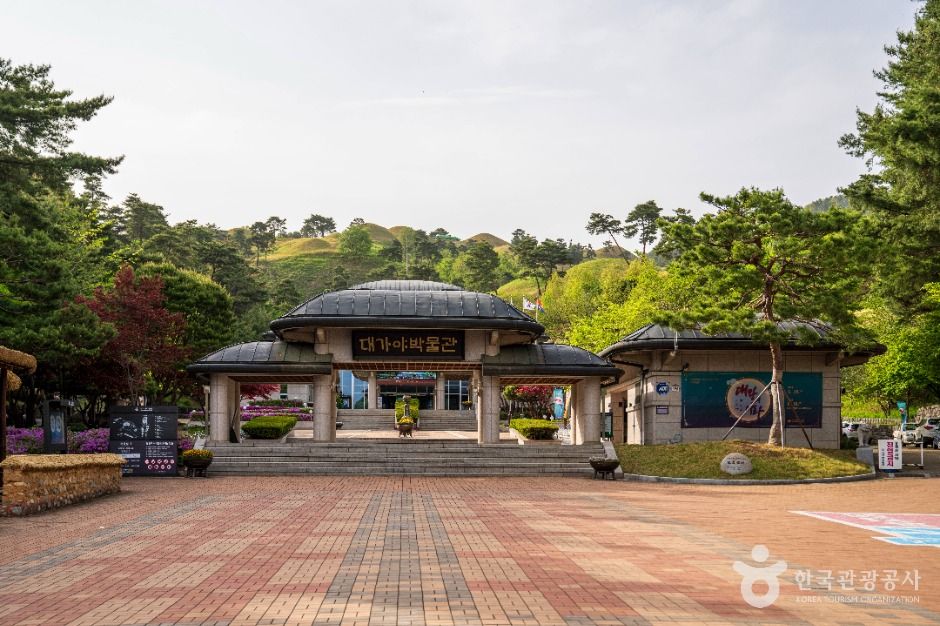
The Daegaya Museum is Korea's only museum dedicated to Daegaya, presenting the history and culture of Daegaya and the Goryeong area. The Korea Tourism Organization says it sits at the foot of the Jisandong Ancient Tombs and comprises the Daegaya Royal Tomb Exhibition Hall, the Daegaya History Hall and the Ureuk Museum in Jeongjeonggol, home of Ureuk, who created the gayageum. Admission is free and it is closed on Mondays. The exhibition halls open 9:00 to 18:00 in summer and 9:00 to 17:00 in winter, with last entry an hour before closing. The commentary runs from rock carvings through the founding myth, gilt-bronze crowns and earrings, iron and armour, to the fall in 562 and the story of Crown Prince Wolgwang. Inquiries: +82-54-950-7103.
- Location: 1203 Daegaya-ro, Daegaya-eup, Goryeong-gun, Gyeongsangbuk-do
- Admission: Free
- Exhibition halls: Summer 9:00 to 18:00 (last entry 17:00); winter 9:00 to 17:00 (last entry 16:00)
- Children’s learning centre: Summer 9:30 to 17:00; winter 9:30 to 16:30
- Closed: Mondays (if a public holiday, the first weekday after it)
- Inquiries: Daegaya Museum +82-54-950-7103; Ureuk Museum +82-54-950-7136
- Parking: Check on site
What is the Daegaya Museum?
It comprises the Royal Tomb Exhibition Hall, the History Hall and the Ureuk Museum, displaying ornaments such as gilt-bronze crowns from the Jisandong Ancient Tombs, pottery such as long-necked jars and cylindrical stands, and weapons such as ring-pommel swords with phoenix designs and armour. The tombs above the museum are covered in the Jisandong Ancient Tombs guide. Which months count as summer isn't in the Korea Tourism Organization data, so check on site. The children's learning centre opens 30 minutes later and closes earlier than the halls.
| Facility | Summer | Winter |
|---|---|---|
| Exhibition halls | 9:00 to 18:00, last entry 17:00 | 9:00 to 17:00, last entry 16:00 |
| Children’s learning centre | 9:30 to 17:00, last entry 16:40 | 9:30 to 16:30, last entry 16:10 |
How did Daegaya rise and fall?
The commentary introduces the founding myth from the early-Joseon geography Dongguk Yeoji Seungnam: Jeonggyeonmoju, the mountain goddess of Gayasan, met a god of heaven and bore Noejil Juil, king of Daegaya, and Noejil Cheongye, king of Geumgwan-guk, notable for centring a goddess. Compared with the myth of King Kim Suro of Geumgwan Gaya, it is read as reflecting rivalry between the two states.
The commentary says that when King Gwanggaeto of Goguryeo attacked Gaya in 400, the inland state of Banpa escaped harm and absorbed its neighbours to become Daegaya. Its decline ran through attacks on the Gaya confederation by King Muryeong of Baekje in the early 6th century, a marriage alliance with Silla that soured over a dispute about attendants, and finally conquest by Silla in 562. The story of Crown Prince Wolgwang, said to be the last crown prince, also appears; parts of the commentary are dramatised with dialogue and should be distinguished from historical fact.
Which artefacts should I look for?
The commentary presents Daegaya as a kingdom of iron that mass-produced tools and weapons using iron from the Yaro area of Hapcheon. Helmets were made by lacing dozens of iron plates of set size, and armour from wide iron plates joined together. Miniature iron objects are small copies of everyday tools, many of them axes and sickles.
The museum's pride is the gilt-bronze crown from Jisan-dong Tomb 32; a small gilt-bronze crown came from Tomb 30, found with a child's skull. The gold crown on display is a precise replica of one held elsewhere. Earrings in the Daegaya style have fine rings with ball ornaments, compared with Silla's thick rings. For the home of the gayageum, see the Ureuk Museum; for the area, the Goryeong guide.
- Check Monday closures and the rule after public holidays.
- Phone to confirm which months follow summer hours.
- Last entry is an hour before closing.
- Plan the Royal Tomb Exhibition Hall and the tombs for the same day.
Who is it for?
- Gaya history beginners: from founding myth to fall in one story.
- Artefact lovers: gilt-bronze crowns, earrings and armour up close.
- Families: there is a separate children’s learning centre.
- Free visits: admission is free.
FAQ
How much is admission?
Free, according to the Korea Tourism Organization.
When is it closed?
Every Monday; if Monday is a public holiday, the first weekday after it.
What time is last entry?
17:00 in summer and 16:00 in winter.
Is the Ureuk Museum part of it?
The tourist information lists the Ureuk Museum as one of the Daegaya Museum’s facilities.
Sources
- Korean-language tourist information (Daegaya Museum overview, visitor information) · Korea Tourism Organization TourAPI · accessed 2026-10-23
- Tourism storytelling commentary (Daegaya founding myth, gilt-bronze crowns, ironware, the fall) · Korea Tourism Organization storytelling database · accessed 2026-10-23
Fees, hours and programmes can change, so check the latest information before you visit.
Information was checked against the official sources listed above. Opening hours, fees and fares can change; please confirm with the venue or operator before you visit.