
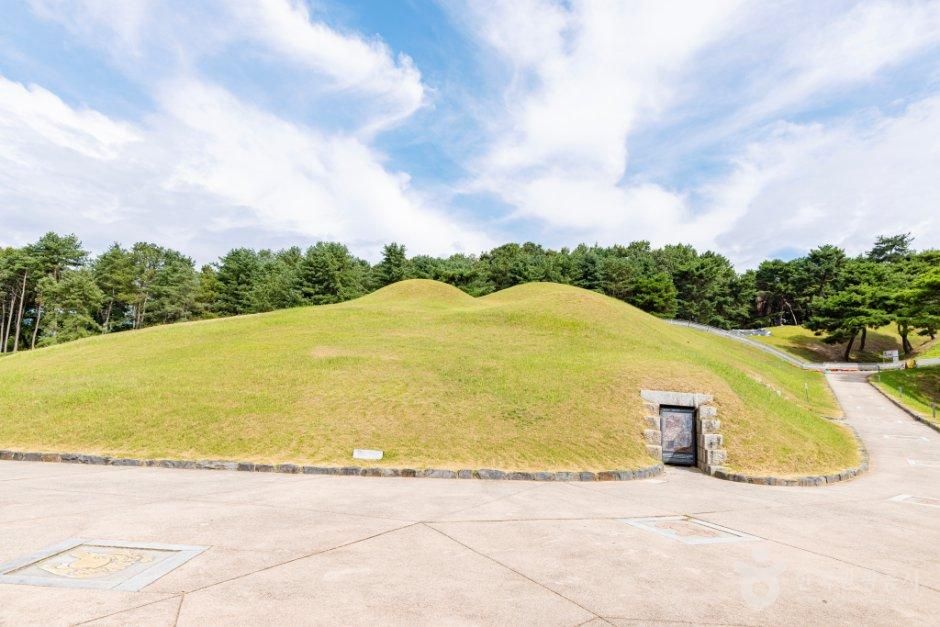
The Tomb of King Muryeong is one of the few ancient royal tombs whose occupant is known precisely, thanks to epitaph stones inside, and you can visit at the Songsan-ri royal tombs in Gongju for 3,000 won (adults). It was found intact in 1971 during drainage work for a neighbouring tomb, with King Muryeong, who died in 523 aged 62, and his queen, who died in 526. For conservation, you now see the structure and grave goods through a replica rather than the real chamber. Last entry is 17:30 from March to October and 16:30 from November to February, and entry is free for everyone on the last Wednesday of each month. It is about 1.1 km in a straight line from Gongsanseong, so they pair well in one day.
- Location: 37 Wangneung-ro, Gongju, Chungcheongnam-do
- Admission: Adults 3,000 won; youth 2,000 won; children 1,000 won
- Free: Aged 65 and over, people with disabilities, preschool children; everyone on the last Wednesday of the month
- Hours: March to October 9:00 to 18:00 (last entry 17:30); November to February 9:00 to 17:00 (last entry 16:30)
- Guided tours: On the hour, 9:00 to 16:00
- Inquiries: +82-41-856-3151
What kind of tomb is it?
Seven tombs of Ungjin-period Baekje kings survive here, on a slope south of the Geumgang: King Muryeong's tomb with Tombs 5 and 6 to the west of a valley, and Tombs 1 to 4 to the north-east. Tombs 1 to 5 are stone-chamber tombs with passages; Tomb 6 and King Muryeong's tomb are brick tombs of a type popular in China, new to Baekje and evidence of active exchange with the Liang dynasty of southern China.
What makes it special is the epitaph stones. Of the two slabs, the right one is the king's and the left the queen's. The king's records that King Sama, that is Muryeong, died in 523 aged 62; the queen's records her death in 526 and that the tomb site was bought from the earth gods, almost a land contract, paid with Liang coins. Since most ancient tombs are anonymous, these two stones became a reference point for dating Baekje, Silla, Goguryeo and East Asia. Muryeong, the 25th king, revived Baekje after the move to Ungjin, balancing noble factions, expanding irrigation, gradually retaking land from Goguryeo and strengthening ties with Liang. Until his tomb was found in 1971, most Baekje royal tombs had been found empty.
Admission, guided tours and free days
| Category | Individual | Group (20+) |
|---|---|---|
| Adults | 3,000 won | 2,500 won |
| Youth | 2,000 won | 1,500 won |
| Children | 1,000 won | 500 won |
Cards are accepted and parking is free. Heritage guides lead tours on the hour; groups have a separate booking number. For English and Japanese guidance, ask on +82-41-840-2260 or +82-41-856-3151. It is closed on 1 January and on Seollal and Chuseok days. Gongsanseong has separate admission, so check both if visiting together.
Can I go inside the tomb?
No. The commentary says public access stopped in 1996 because the bricks were sagging and damp was building up; you now see a replica. Inside is an arched chamber with a raised floor for the king and queen, walls of lotus-pattern bricks and niches for flame-shaped lamps, thought to have burned during the final rites until the oil ran out after the entrance was sealed. The design made it easy to add the queen later but, unlike Silla tombs piled with stones, its entrance made it vulnerable to looting; it survived because no one knew it was there.
Songsan-ri Tomb 6 next to it is also closed and restored: a brick arched chamber with faint murals of the four guardian animals. It was looted empty because its size made people mistake it for King Muryeong's tomb, which kept the real one safe, and it was while digging a drain to dry Tomb 6 that the intact royal tomb was found. Tomb 6 has murals that King Muryeong's tomb lacks, so seeing both shows the difference.
How was the brick tomb built, and where did the coffin wood come from?
The commentary describes five steps: make the wooden coffin, gather bricks and grave goods, prepare the site and build the tomb. Bricks of different shapes and patterns were fitted like a puzzle into an arch without mortar, over a timber frame later removed; there are more than 30 brick shapes. In 1991 a Kyungpook National University researcher examined coffin samples under a microscope and identified Japanese umbrella pine (koyamaki), which grows only in southern Japan and resists rot and damp. Since ancient Japan mainly used stone coffins, the wood is thought to have been imported and the coffin made in Baekje, evidence of close ties with Japan under King Muryeong.
Which artefacts should I look for?
| Artefact | What to look for |
|---|---|
| Tomb guardian beast | A one-horned winged stone beast that guarded the tomb and guided the soul to heaven. Its right hind leg is broken, and similar Chinese tombs show the same, suggesting it was broken deliberately |
| Gilt-bronze shoes | Put on the king after death, decorated with turtle-shell, lotus and phoenix patterns, with studs on the soles |
| Bronze iron | A very long-handled iron; the same form appears at Liang sites and in a kofun in Osaka, Japan, tracing exchange routes |
| Pillows and footrests | Black for the king, red for the queen, decorated with gold-plate turtle-shell patterns |
| Ring-pommel sword with dragon and phoenix | A dragon holding a pearl in the ring; dragons and phoenixes were the highest-status motifs |
| Gold crown ornaments | Flame-shaped gold sheets; the king’s are elaborate, the queen’s smaller and calmer |
| Three bronze mirrors | Inscribed with wishes for long life and many descendants; the polished face reflected the face |
The commentary gives the discovery moment: at 15:00 on 8 July 1971 the entrance was fully exposed, and when the sealing bricks were removed, the guardian beast glared out in front of the two stone slabs. A costume reconstruction shows a Baekje king in a wide-sleeved purple robe with a leather belt.
- Last entry varies by season: 17:30 from March to October, 16:30 from November to February.
- Time your entry with an hourly guided tour; groups should book first.
- Entry is free on the last Wednesday of each month, so allow for queues.
- If visiting Gongsanseong the same day, spot the tomb’s direction from Geumseoru.
Who is it for?
- Artefact lovers: the guardian beast, gilt-bronze shoes and bronze iron each tell a story of exchange with China and Japan.
- Pairing with Gongsanseong: see the tomb’s direction from Geumseoru first.
- Families: hourly tours and the replica make for a short, guided visit.
- Free-day visitors: the last Wednesday of each month is free.
See the Gongju guide for the area, and for Sabi-period Baekje, the Buyeo guide.
FAQ
How much is admission?
Individual adults 3,000 won, youth 2,000 won, children 1,000 won; groups of 20+ 2,500, 1,500 and 500 won.
When is it free?
For people aged 65 and over, people with disabilities and preschool children, and for everyone on the last Wednesday of each month.
Can I go inside the real tomb?
No, the chamber is closed for conservation; a replica shows the structure and grave goods.
When are the guided tours?
On the hour from 9:00 to 16:00, led by heritage guides in Korean; groups need to book. Ask about English and Japanese guidance by phone.
Is it ever closed?
On 1 January and on Seollal and Chuseok days.
Sources
- Korean-language tourist information (Gongju Tomb of King Muryeong and royal tombs, admission, hours, guided tours) · Korea Tourism Organization TourAPI · accessed 2026-10-23
- Tourism storytelling commentary (Building the tomb, Songsan-ri Tomb 6, epitaph stones, guardian beast, wooden coffin) · Korea Tourism Organization storytelling database · accessed 2026-10-23
Fees, hours and programmes can change, so check the latest information before you visit.
Information was checked against the official sources listed above. Opening hours, fees and fares can change; please confirm with the venue or operator before you visit.