
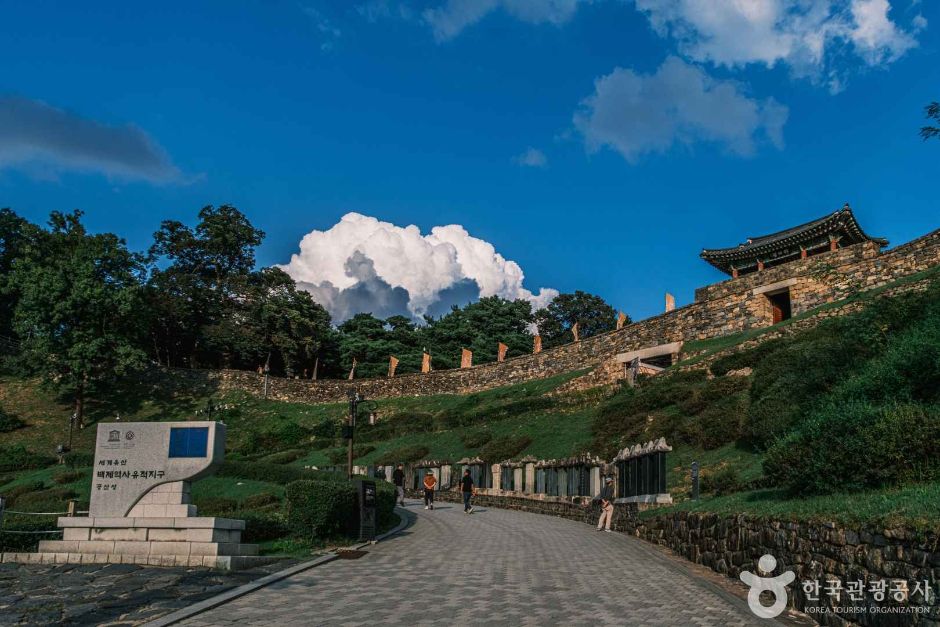
Gongsanseong is the mountain fortress Baekje used as its royal citadel in the Ungjin period; along the walls above the Geumgang River you pass the palace site, ponds and traces of the earthen wall. Baekje held out here for 63 years after Hanseong fell, and the choices of that era are visible throughout. Walk from the entrance to Geumseoru, the presumed palace site in front of Ssangsujeong, the earthen wall outside the east gate, the restored Imnyugak and the square pond, the same order as the commentary. Adults pay 3,000 won; it closes at 18:00 from March to October and 17:00 from November to February, and is closed on 1 January and on Seollal and Chuseok days.
- Location: 280 Ungjin-ro, Gongju, Chungcheongnam-do
- Admission: Adults 3,000 won; youth and military 2,000 won; children 1,000 won
- Hours: March to October 9:00 to 18:00; November to February 9:00 to 17:00 (last entry 30 minutes before closing)
- Closed: 1 January, Seollal and Chuseok days
- Parking: Available, free
- Inquiries: Gongju tourist information centre +82-41-856-7700
What is Gongsanseong, and why did Baekje move here?
The Korea Tourism Organization introduces it as the royal fortress guarding the capital in the Ungjin period: an earthen fortress enclosing ridges and a valley at 110 m above sea level beside the Geumgang, likened in the commentary to a nest with a mother bird sheltering her chicks. It was Ungjinseong in Baekje times, Gongjusanseong in Goryeo and Gongsanseong afterwards, and was also called Ssangsusanseong after King Injo sheltered here from the Yi Gwal rebellion. The stone walls seen today were rebuilt under Joseon kings Seonjo and Injo.
The Ungjin period lasted 63 years and five kings, from King Munju's move south until King Seong moved the capital to Sabi. The commentary explains the choice by terrain: the river blocked Goguryeo from the north and Gyeryongsan to the east helped hold off Silla; a low riverside hill made it easy to watch for enemies and to come and go. Even after the move, clashes between nobles from Hanseong and local powers saw kings killed in succession, until King Muryeong restored order, balancing old and new nobles, sending royals out as governors and expanding irrigation along the Geumgang, the stability that made the move to Sabi succeed.
Admission, hours and closing days
| Category | Individual | Group (20+) |
|---|---|---|
| Adults (19 to 64) | 3,000 won | 2,500 won |
| Youth and military | 2,000 won | 1,500 won |
| Children (7 to 12) | 1,000 won | 500 won |
Parking is available and free, and there are toilets. Entry ends 30 minutes before closing in every season. During the autumn Baekje Cultural Festival, a floating bridge is said to run from in front of Gongsanseong to Geumgang Singwan Park, giving another view up at the walls from across the river.
Which order should I walk in?
The commentary runs entrance, Geumseoru, the presumed palace site, Yeongdongru (east gate), Imnyugak and the lotus pond. Following the ridge this way, the climbs come first and the route gets closer to the river as you go. Wear comfortable shoes, as there are slopes and dirt paths.
| Stop | What to look for |
|---|---|
| Geumseoru | The west gate, with views of central Gongju and towards the Tomb of King Muryeong |
| Presumed palace site by Ssangsujeong | Baekje building sites and a round pond, beside the Ssangsujeong pavilion where King Injo stayed |
| Yeongdongru (east gate) | Traces and a cross-section of the Baekje earthen wall below the stone wall |
| Imnyugak | A two-storey pavilion restored on a site excavated in 1980 |
| Lotus pond and Manharu | An angular stepped pond and a late-Joseon pavilion facing the Geumgang |
What can you see from Geumseoru?
Standing on the gate, the large mound in the distance at eleven o'clock is the Tomb of King Muryeong; at two o'clock, the small hill to the right of a tunnel is the Jeongjisan site, a place of state rites interpreted as where King Muryeong and his queen lay in state. An ice-storage facility was found there, thought to have kept the bodies from decaying during the two to three years before burial. The commentary also mentions leather armour found near a reservoir inside the fortress, inscribed with an era name of Emperor Taizong of Tang that dates it to 645; some scholars think it is Chinese because Baekje did not use that era name, so debate continues. The royal tombs are a separate ticketed site; see the Tomb of King Muryeong and royal tombs.
The palace site, Imnyugak and the lotus pond
Excavation began in 1985 from a Samguk Sagi record that Imnyugak stood east of the palace, revealing several large building sites, lotus-pattern roof-end tiles and tiles inscribed with the character for palace. The round pond in front, wide at the top and narrow at the bottom, is largely original. A record says King Dongseong dug a pond and kept rare birds, but it cannot be confirmed as this one.
Imnyugak was restored after its site was found in 1980, based on the remains and records; the Samguk Sagi says it was built in the 22nd year of King Dongseong, AD 500. It is a large two-storey banquet pavilion. The commentary says Dongseong feasted here all night even as starving people fled to Goguryeo, and shut the palace gates against ministers' petitions; he was eventually killed by an assassin. The lotus pond beside Manharu is one of two confirmed of three ponds said to have existed; unlike the round palace pond, it is angular, built in neat stone steps narrowing downward, like an upside-down stone pagoda. Manharu, a late-Joseon pavilion, is a good place to rest facing the river.
Where can I see the Baekje earthen wall?
Near the east gate, Yeongdongru: leave through the gate and look down to the right. The fortress was earthen in Baekje times and rebuilt in stone in Joseon, and this is the only place where the Baekje wall is visible. Fine earth was rammed into square timber frames, then twigs and leaves were laid and more earth rammed, layer on layer like rice cake; this is called the buyeop technique, also used at Mongchontoseong and Pungnaptoseong in Seoul. The commentary reads the labour it required as evidence of strong royal power. The earthen wall runs for about 467 m along the ridge, worth walking if you have extra time.
- Adults 3,000 won; entry ends 30 minutes before closing, so plan from the last entry time.
- Find the directions to the Tomb of King Muryeong and Jeongjisan from Geumseoru first.
- Look down to the right after leaving the east gate for the earthen-wall section.
- Ask the Gongju tourist information centre (+82-41-856-7700) about the floating bridge during the Baekje Cultural Festival.
Who is it for?
- First-time visitors to a Baekje capital: the reasons for the move, the palace site and the wall technique in one walk.
- Pairing with the royal tombs: spot the Tomb of King Muryeong from Geumseoru, then visit it separately.
- Photographers: Geumgang Singwan Park offers night views of the fortress.
- Shorter walks: you can see just Geumseoru and the palace site near the entrance.
See the Gongju guide for the area.
FAQ
How much is admission?
Individual adults 3,000 won, youth and military 2,000 won, children 1,000 won; groups of 20+ 2,500, 1,500 and 500 won.
Is it ever closed?
On 1 January and on Seollal and Chuseok days; otherwise it follows the seasonal hours.
Can I see the Tomb of King Muryeong from it?
Yes, at eleven o’clock from the top of Geumseoru. The tomb site needs a separate ticket.
Is there parking?
Yes, and it is free.
Can I visit at night?
Entry ends before dark, but you can see the fortress lit up at night from Geumgang Singwan Park.
Sources
- Korean-language tourist information (Gongju Gongsanseong, admission, hours, closing days) · Korea Tourism Organization TourAPI · accessed 2026-10-23
- Tourism storytelling commentary (Gongsanseong entrance, Geumseoru, palace site, Yeongdongru, Imnyugak, lotus pond) · Korea Tourism Organization storytelling database · accessed 2026-10-23
Fees, hours and programmes can change, so check the latest information before you visit.
Information was checked against the official sources listed above. Opening hours, fees and fares can change; please confirm with the venue or operator before you visit.