
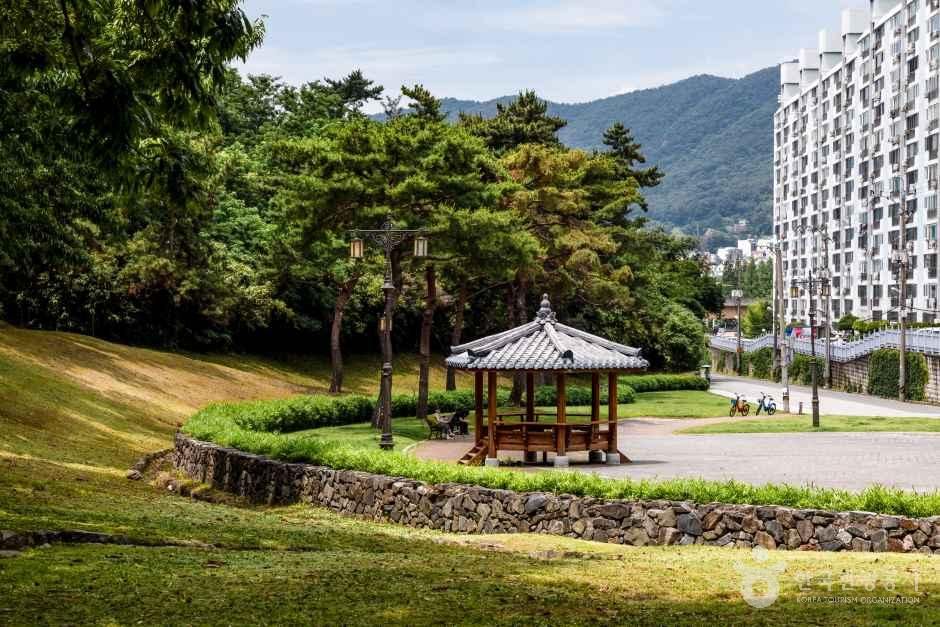
Gujibong is a small peak in Gusan-dong, Gimhae, where King Suro, founder of Gaya, is said to have been born. The Korea Tourism Organization says it was designated a Gyeongsangnam-do Monument on 6 August 1983 and changed to a national Historic Site on 7 March 2001. It was originally called Gusubong for its resemblance to a turtle's head, and on top are a southern-type dolmen thought to date from around the 4th century BC and the inscription "Gujibongseok". Admission is free, it is always open, every day of the year, and parking is available. Inquiries: Gimhae tourist information centre, +82-55-338-1330.
- Location: Gusan-dong, Gimhae, Gyeongsangnam-do
- Admission: Free
- Hours: Always open, all year
- Parking: Available
- Designation: Historic Site (changed on 7 March 2001)
- On the summit: Southern-type dolmen and the Gujibongseok inscription
- Inquiries: Gimhae tourist information centre +82-55-338-1330
What is Gujibong?
The flat area where the tomb of King Suro's queen now lies is the turtle's body, and the peak jutting west looks like its head, hence the old name Gusubong. The summit dolmen, from around the 4th century BC, has a capstone on short supports, carved with the characters Gujibongseok, said to be by the calligrapher Han Ho. The commentary notes that the area around the dolmen is closed off. It is only a low hill, but it is the setting of Gaya's founding myth; the hero's tomb is at the Tomb of King Suro.
| Item | Details (Korea Tourism Organization data) |
|---|---|
| Old name | Gusubong (turtle’s head) |
| Designation | 1983 Gyeongsangnam-do Monument; 2001 Historic Site |
| Summit remains | Southern-type dolmen, around 4th century BC |
| Inscription | Gujibongseok (said to be by Han Ho) |
The myth of the six golden eggs
Before Gaya was founded, nine chiefs ruled the Gimhae area. In AD 42 a voice from heaven was heard at Gujibong; as people sang and danced, six golden eggs wrapped in red cloth came down. After 12 days they hatched into boys; the first-born was King Suro, a name meaning the first born in the world, and the other five founded small states such as Daegaya, Ara Gaya and So Gaya, making Gaya a confederation.
The commentary divides Korean founding myths into the northern type, where a child of heaven descends, and the southern type, where a founder hatches from an egg, and says the Gaya myth mixes both, so some see Gaya as founded by northern migrants joining local powers. Similarities with Japanese founding myths have led to speculation that Geumgwan Gaya's elite crossed to Japan, but the commentary itself calls this speculation.
What can you see from the top?
From the viewing deck you look over Gimhae, with the Gaya royal tombs and a museum of Gaya artefacts in front; see the Ancient Tombs in Daeseong-dong, Gimhae. The commentary says that although no sea is visible today, when Gaya rose Gimhae was a tidal sea with broad mudflats, as shown by the oysters, clams and cockles in local shell mounds; sea routes let it trade with neighbours and grow into a maritime kingdom. Shell-mound displays are at the Bonghwang-dong site shell mound exhibition hall. See the Gimhae guide for the area.
- Respect the restricted area around the dolmen.
- Find the tombs from the summit deck.
- Plan your order with the Tomb of King Suro and the Ancient Tombs in Daeseong-dong, Gimhae.
- For inquiries, call +82-55-338-1330.
FAQ
How much is admission?
Free, always open and open every day.
Is there parking?
Yes, according to the Korea Tourism Organization.
Where does the name come from?
The peak resembles a turtle’s head, so it is written with the character for turtle.
What is on the summit?
A southern-type dolmen from around the 4th century BC, the Gujibongseok inscription and a viewing deck.
Sources
- Korean-language tourist information (Gimhae Gujibong overview, visitor information) · Korea Tourism Organization TourAPI · accessed 2026-10-23
- Tourism storytelling commentary (Gujibong myth, Gaya and Japanese myths compared, the sea at Gimhae) · Korea Tourism Organization storytelling database · accessed 2026-10-23
Fees, hours and programmes can change, so check the latest information before you visit.
Information was checked against the official sources listed above. Opening hours, fees and fares can change; please confirm with the venue or operator before you visit.