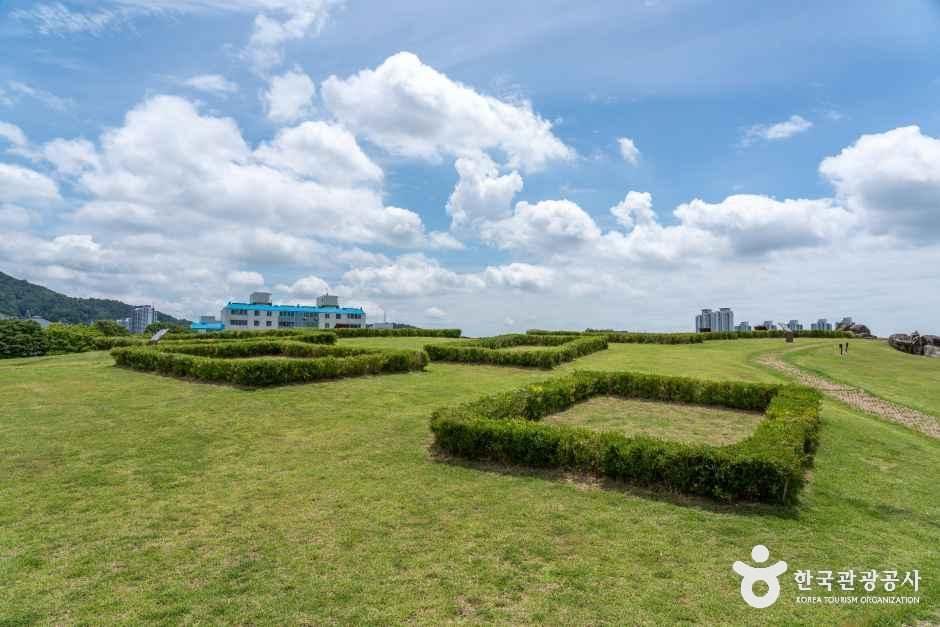
For a Gaya trip in Gimhae, combine three places: the Royal Tomb of King Suro, Gujibong Peak and the Daeseong-dong Tombs. According to the Korea Tourism Organization, all three are free and have parking; Gujibong and the Daeseong-dong Tombs are always open, while the Royal Tomb of King Suro opens at 8:00 or 9:00 and closes between 18:00 and 20:00 depending on the season. Calculated from Korea Tourism Organization coordinates, the straight-line distance from the Royal Tomb of King Suro is about 0.5 km to the Daeseong-dong Tombs and about 0.9 km to Gujibong. The commentary begins with the golden-egg myth of Gujibong and continues with the legend of King Suro and Queen Heo and the stories of Geumgwan Gaya, the iron kingdom, and its wooden-chamber tombs. Comparing it with Daegaya in Goryeong helps you understand the two centers of the Gaya confederacy together.
- Royal Tomb of King Suro: Free, open all year, seasonal hours
- Gujibong Peak: Free, always open
- Daeseong-dong Tombs: Free, always open
- Straight-line distance: Royal Tomb of King Suro to Daeseong-dong about 0.5 km, to Gujibong about 0.9 km
What is there to see in Gimhae?
The commentary introduces Gimhae as the center of Geumgwan Gaya. The myth that King Suro was born from the first of six golden eggs to hatch after descending from the sky begins at Gujibong. According to the Korea Tourism Organization, King Suro took the throne in AD 42 as the founder of Garakguk, and in AD 48 took as his queen Heo Hwang-ok, a princess of Ayuta.
Detailed plans for the three places are in the Royal Tomb of King Suro guide (in Korean), the Gujibong guide (in Korean) and the Daeseong-dong Tombs guide (in Korean). The later center of Gaya is covered in our Goryeong guide.
How do the opening hours and fees differ?
The times in the table are based on Korea Tourism Organization tourist information. The hours of the Daeseong-dong Tombs Museum are not in this data, so check on site.
| Site | Fee | Opening hours | Parking |
|---|---|---|---|
| Royal Tomb of King Suro | Free | March and October 8:00–19:00, April–September 8:00–20:00, November–February 9:00–18:00 | Available, free |
| Gujibong Peak | Free | Always open | Available |
| Daeseong-dong Tombs | Free | Always open | Available |
Check before you plan your Gimhae day
- Check the seasonal opening hours of the Royal Tomb of King Suro and decide when to arrive.
- If you would like a Korean-language guide, book in advance with the Royal Tomb of King Suro management office at +82-55-332-1094.
- Ask about the hours of the Daeseong-dong Tombs Museum at +82-55-350-0426.
- Respect the no-entry signs around the dolmen at Gujibong.
The Korean-language guide service at the Royal Tomb of King Suro is available by advance booking. Gujibong and the Daeseong-dong Tombs are listed as open all year, but the museum and exhibition hall within the tomb area may have their own closing days, so call before you visit.
How close are the three sites?
These are straight-line distances calculated from the coordinates in Korea Tourism Organization tourist information. Actual walking routes and times are not in the Korea Tourism Organization data, so we could not check them. The information on the Daeseong-dong Tombs says they lie between Gujibong and the Hoehyeon-ri shell mound, with the Royal Tomb of King Suro next door to the east, so the three can be seen as one connected area.
The commentary says that from the observation deck at the top of Gujibong you can look down on the tombs and the artifact exhibition hall in front. The Gujibong commentary also mentions that in the Gaya period Gimhae was a sea with tidal flats, and that shell-mound exhibits can be seen at the shell mound exhibition hall of the Bonghwang-dong site.
| Route | Straight-line distance (from coordinates) |
|---|---|
| Royal Tomb of King Suro to Daeseong-dong Tombs | About 0.5 km |
| Gujibong to Daeseong-dong Tombs | About 0.7 km |
| Royal Tomb of King Suro to Gujibong | About 0.9 km |
What kind of kingdom was Geumgwan Gaya?
The commentary says that from the 2nd century onward Gaya produced large amounts of iron in Gimhae, made weapons and farm tools, and from the 3rd century exported to Nangnang and Japan. Gimhae was an important port city on the sea route from China to Japan and was also linked to the interior by the Nakdonggang River. It also notes that Geumgwan Gaya was shaken by war with Goguryeo in the late 4th and early 5th centuries.
The commentary on the legend of Queen Heo, the twin-fish motif and the Pasa Stone Pagoda involves stories whose interpretation is disputed, so read them as legend. For specific explanations of the Royal Tomb of King Suro and the Daeseong-dong Tombs, see each detailed guide.
What kind of trip is Gimhae good for?
Good for:
- Myths and historic sites: Gujibong, the Royal Tomb of King Suro and the Daeseong-dong Tombs are in one area.
- A free day out: none of the three charges a fee.
- Comparing Gaya: compare the two centers of the Gaya confederacy together with Daegaya in Goryeong.
Gimhae FAQ
Do the Gaya sites in Gimhae charge admission?
According to Korea Tourism Organization information, the Royal Tomb of King Suro, Gujibong and the Daeseong-dong Tombs are all free.
How close are the three sites?
The straight-line distances calculated from coordinates are all under 1 km. We could not confirm actual walking times.
How late is the Royal Tomb of King Suro open?
Until 20:00 from April to September, 19:00 in March and October, and 18:00 from November to February.
Can I hear a Korean-language commentary?
At the Royal Tomb of King Suro, the Korean-language guide service is available by advance booking.
Sources
- Korean-language tourist information (Royal Tomb of King Suro, Gujibong, Daeseong-dong Tombs) · Korea Tourism Organization TourAPI · accessed 2026-10-23
- Tourism storytelling commentary (the myth of King Suro, the legend of Queen Heo, the iron and trade of Geumgwan Gaya) · Korea Tourism Organization storytelling database · accessed 2026-10-23
Information was checked against the official sources listed above. Opening hours, fees and fares can change; please confirm with the venue or operator before you visit.