
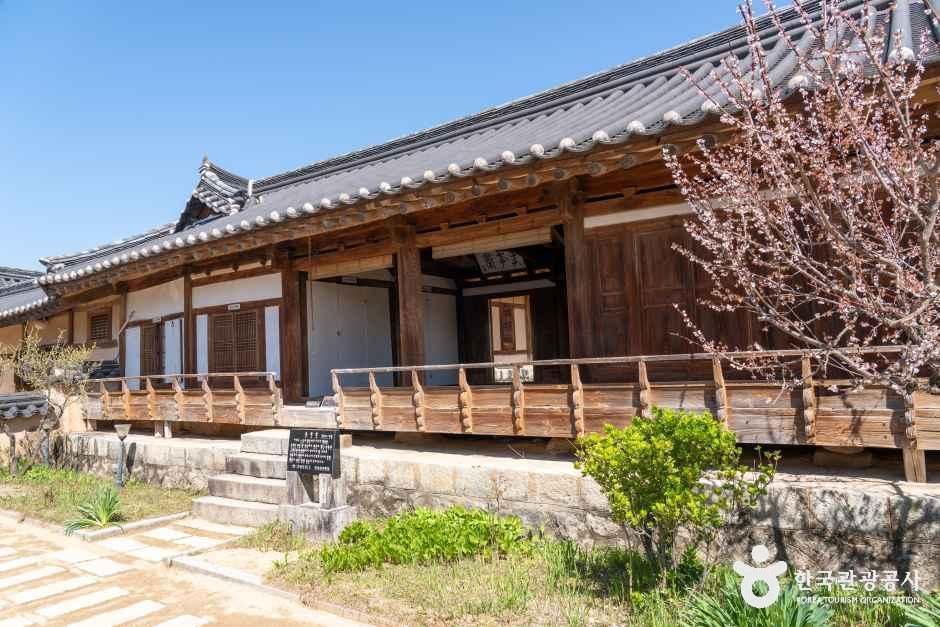
Hahoe Village is a clan village where the Pungsan Ryu family has lived for generations; for 5,000 won (adults) you can walk among its old houses with views of the Nakdonggang River. It is known for descendants still living in and continuing the traditions of a Joseon-era yangban (aristocratic) village. The name Hahoe comes from the way the river wraps round the village in an S-shaped bend, and in 2010 it was inscribed as a UNESCO World Heritage Site together with Yangdong Village in Gyeongju, as the Historic Villages of Korea. From April to September it opens 9:00 to 18:00 and from October to March 9:00 to 17:00, with last entry 30 minutes before closing, every day of the year. Guided walks with a cultural tourism guide run six times a day and must be booked online seven days ahead.
- Location: 186-8 Jeonseo-ro, Pungcheon-myeon, Andong, Gyeongsangbuk-do
- Admission: Adults 5,000 won; youth and uniformed service personnel 2,500 won; children 1,500 won
- Hours: April to September 9:00 to 18:00 (last entry 17:30); October to March 9:00 to 17:00 (last entry 16:30)
- Closed: Open all year
- Guided walks: Daily at 10:00, 11:00, 13:00, 14:00, 15:00 and 16:00
- Parking: Free
- Inquiries: Visitor centre +82-54-840-3795
What kind of village is Hahoe, and why the name?
According to the Korea Tourism Organization, Hahoe is a typical clan village of the Pungsan Ryu family and the birthplace of the Joseon scholars Gyeomam Ryu Un-ryong and Seoae Ryu Seong-ryong. A ridge of Hwasan mountain to the east reaches into the village as a low hill, and because the houses face down from the hill, they point in every direction. Large tiled houses of the Ryu family stand at the centre, surrounded by well-preserved thatched houses.
The storytelling commentary opens in the voice of the clan's eldest daughter-in-law. With mountains behind and the river in front, the village looks like a lotus floating on water and is considered an auspicious site in feng shui; it is also called Muldori-dong, the village the water turns around. Dozens of men from the village passed the Joseon state examinations, and Ryu Seong-ryong, author of the Jingbirok, came from here. Queen Elizabeth II visited on 21 April 1999, the third day of her trip to Korea, which made it more widely known.
Admission and guided walks
The figures below are from Korea Tourism Organization tourist information.
| Category | Adults | Youth and uniformed personnel | Children |
|---|---|---|---|
| Individual | 5,000 won | 2,500 won | 1,500 won |
| Group (30+) | 4,000 won | 2,000 won | 1,200 won |
| Andong and Yecheon residents | 1,000 won | 500 won | 400 won |
Admission is free for people aged 65 and over, people with severe disabilities (grades 1 to 3) plus one companion, and people with grade 4 disabilities. Guided walks with a cultural tourism guide leave from the front of the Hahoe Village visitor centre on the hour at 10:00, 11:00, 13:00, 14:00, 15:00 and 16:00. Book online seven days before your visit, and contact the guide directly to cancel or change. The Korean-language line is +82-54-840-3803 and the foreign-language line +82-54-840-3795. Programmes such as a traditional wedding experience, seasonal customs and writing family mottos are also listed. For the wider area, see the Andong guide.
Which old houses should I see?
Bukchondaek, Yangjindang and Chunghyodang are the three great houses, each with a story about the person who built it.
Bukchondaek represents the northern quarter where the yangban houses gather, with a tall raised gate. The commentary says it was built by Seokho Ryu Do-seong, a descendant of Ryu Seong-ryong, and separated the quarters of three generations: the head of the family, his son and his grandson. When a boat capsized in the summer flood of 1859, he is said to have thrown timber he had dried for three years to build the house into the river to save the villagers.
Yangjindang is the head house of the Pungsan Ryu clan. It was built by Ryu Jong-hye, the first to settle in the village; part of it burned during the Imjin War (the Japanese invasions of 1592 to 1598), leaving its present size. Its old name, Ibam Gotaek, comes from the pen name of Ibam Ryu Jung-yeong, father of the brothers Gyeomam and Seoae. Chunghyodang, also called the Seoae head house, has a Korean fir in front planted during Queen Elizabeth II's 1999 visit; the present house was rebuilt by Ryu Seong-ryong's grandson and disciples after his death to honour his learning.
Hadong Gotaek, at the entrance to the village, was built by Ryu Gyo-mok, a former county magistrate. Medicine cabinets in its hall are traces of an owner who gave medical help to sick commoners, and its gatehouse alone is thatched, a lesson not to try to have everything. Jakcheon Gotaek has a small screening wall in the yard between the men's and women's rooms so that they would not meet inside the house.
The earthen walls, Samsindang and the mask dance
The commentary explains the walls through feng shui. Because the village was seen as a boat floating with a lotus, people believed that stone walls would sink it, so they built earthen walls instead and dug almost no wells. The pandam wall was made by packing mud and straw between wooden boards and removing them once it set, leaving the board lines that give it its name; the tiles on top stop rain washing the earth away.
Samsindang is a zelkova tree more than 600 years old, said to have been planted by the first Ryu ancestor to settle in Hahoe. Villagers believe a spirit dwells in it and have held village rites at Seonangdang on the night of the first full moon of the lunar year and at Samsindang the next morning. The slips of paper around the tree are written wishes. The Hahoe Byeolsingut Talnori mask dance grew from a ritual held when disasters struck the village; it runs in eight scenes and is now performed regularly. The commentary also tells the legend of Heo Doryeong, who was carving twelve masks when the woman he loved secretly peeked, so he never finished the chin of the Imae mask.
Mansongjeong pines, Buyongdae and Okyeonjeongsa
Mansongjeong is a pine forest on the riverbank in front of Buyongdae and a Natural Monument. The commentary says Gyeomam Ryu Un-ryong planted ten thousand pines on the sandbank to block the harsh energy of Buyongdae and the river and sand winds, making up for a weakness in the village's feng shui.
Buyongdae is a low cliff opposite the village that acts as a buffer, turning the strong current away from Hahoe; it is one of the Sixteen Views of Hahoe, and the village can be seen from the top. A ferry boat is said to run on the water in front of it. At its foot, Okyeonjeongsa is where Seoae wrote the Jingbirok, a National Treasure and memoir of the causes and course of the Imjin War. He lived too modestly to afford to build it, and it took ten years to finish with help from the monk Tanhong. Yeongmogak displays Seoae's appointment as chief state councillor, his clothing and other belongings.
- Book a guided walk online seven days ahead.
- From October to March last entry is 16:30, so plan afternoon visits early.
- Bring proof if you qualify for a discount or free entry (for example, aged 65 and over).
- In autumn, check the dates of the Andong International Mask Dance Festival.
Who is Hahoe Village for?
- Hanok and wall lovers: Bukchondaek, Yangjindang, Chunghyodang and the earthen-wall lanes are close together.
- Readers of the Jingbirok: follow Ryu Seong-ryong’s story at Chunghyodang, Yeongmogak and Okyeonjeongsa.
- Mask dance fans: there are regular Hahoe Byeolsingut Talnori performances, and the Andong International Mask Dance Festival is held in autumn.
- Families: children pay 1,500 won and hands-on programmes are listed.
- Historic village trips: compare it with Yangdong Village in Gyeongju, inscribed with it in 2010; see the Gyeongju guide for more.
FAQ
How much is admission to Hahoe Village?
Individual adults 5,000 won, youth and uniformed personnel 2,500 won, children 1,500 won. Andong and Yecheon residents pay 1,000 won (adults).
What are the opening hours?
April to September 9:00 to 18:00 (last entry 17:30); October to March 9:00 to 17:00 (last entry 16:30), every day of the year.
Who gets in free?
People aged 65 and over, people with grade 1 to 3 disabilities plus one companion, and people with grade 4 disabilities.
How do I join a guided walk?
Book online seven days ahead. There are six walks a day, leaving on the hour; the Korean-language line is +82-54-840-3803 and the foreign-language line +82-54-840-3795.
Sources
- Korean-language tourist information (Andong Hahoe Village, admission, hours, guided walks) · Korea Tourism Organization TourAPI · accessed 2026-10-23
- Tourism storytelling commentary (Hahoe old houses, walls, Samsindang, Mansongjeong, Buyongdae, Okyeonjeongsa) · Korea Tourism Organization storytelling database · accessed 2026-10-23
Fees, hours and programmes can change, so check the latest information before you visit.
Information was checked against the official sources listed above. Opening hours, fees and fares can change; please confirm with the venue or operator before you visit.