
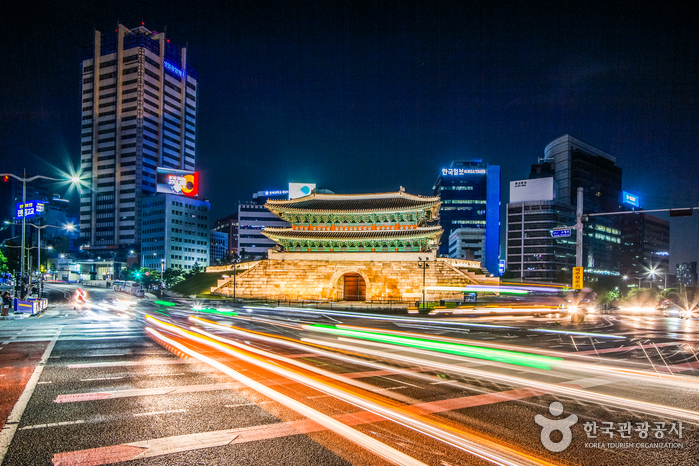
Sungnyemun was the south main gate of the Joseon capital. Because it stands to the south among the four great gates, it is also called Namdaemun ("South Gate"). It is the oldest wooden building still standing in Seoul and was designated a National Treasure on December 20, 1962. It is about 0.9 km in a straight line from Euljiro 1-ga Station, so it is easy to drop by while walking around Euljiro and Myeongdong.
Sungnyemun opening hours and closing days
- Address: 40 Sejong-daero, Jung-gu, Seoul
- Opening hours: 09:00–18:00 (last entry 17:50)
- Closed: Every Monday
- Parking: Not available
- Phone: +82-2-779-8547
Admission fees are not listed separately in the official materials, so we have not included them here. Please check the VISIT SEOUL page on Sungnyemun before you go. There is no car park, so public transport is the better option.
History: from 1396 to the 2013 restoration
Sungnyemun was first built in the 5th year of King Taejo (1396) and rebuilt in February 1398. It underwent major repairs in the 10th year of King Seongjong (1479) and, unharmed by the Imjin War and the Qing invasion, long served as the main gate of Hanseong.
In 1907, the city walls attached to Sungnyemun were torn down on the pretext of a visit by the Japanese crown prince. On February 10, 2008, a fire burned part of the first-floor gate tower and destroyed the second-floor tower. After research and restoration work, a ceremony marking the restoration was held on May 4, 2013, and the gate reopened to the public.
Three things to look for at Sungnyemun
- The vertically written name plaque: Sungnyemun is the largest of Seoul's four great gates, and its name plaque is unusual in being written vertically. According to the Jibong Yuseol, the plaque was written by Grand Prince Yangnyeong, the eldest son of King Taejong.
- The arched gateway and the two-story pavilion: A rainbow-shaped arched gateway (hongyemun) sits in the middle of a tall stone base, topped by a two-story pavilion five bays wide and two bays deep.
- The hipped roof and dapo bracketing: Seen from the front, the roof is a trapezoidal hipped roof (ujingak). The brackets supporting the eaves sit not only on top of the columns but also between them (the dapo style); the gentle curves and sturdy joinery show the features of early Joseon architecture.
Places to visit near Sungnyemun
Follow Sejong-daero north from Sungnyemun to reach Daehanmun, the main gate of Deoksugung Palace; the Namdaemun braised hairtail alley is also close by. You can see all of Euljiro's attractions with photos on our Euljiro attractions map.
Sungnyemun cannot be visited on Mondays. Opening hours and closing days can change, so please check the official information before you go.
Sungnyemun FAQ
Until what time can I visit Sungnyemun?
Opening hours are 09:00–18:00, and last entry is at 17:50.
Is it closed on any day?
It is closed every Monday.
Can I drive there?
The official materials say parking is not available.
When did it become a National Treasure?
It was designated a National Treasure on December 20, 1962.
Sources
- Korea Tourism Organization TourAPI: Sungnyemun (contentId 128162) · Korea Tourism Organization · accessed 2026-10-29
- VISIT SEOUL: Sungnyemun · Seoul Tourism Organization · accessed 2026-10-29
Information was checked against the official sources listed above. Opening hours, fees and fares can change; please confirm with the venue or operator before you visit.