
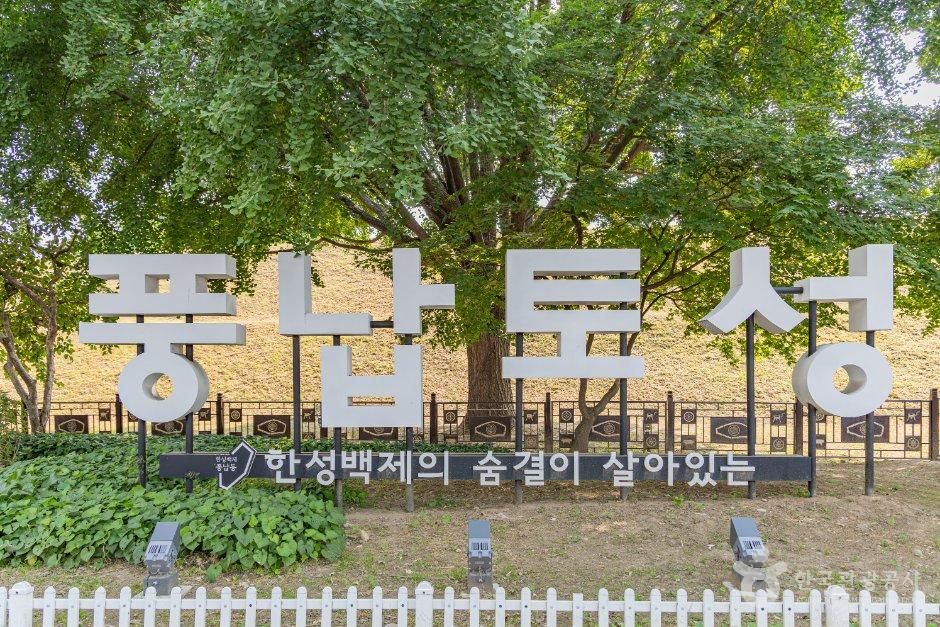
Pungnap Earthen Fortress is a flatland fortress built of earth in the Hanseong period of Baekje, surviving on the bank of the Hangang River in Pungnap-dong, Songpa-gu, Seoul. The Korea Tourism Organization describes it as a boat-shaped fortress; the west wall facing the Hangang has disappeared, leaving only about 2.7 km today, but its original circumference is estimated at 3.7 km. Admission is free, it is always open, and parking is available. When a bronze vessel (cheongdong chodu) and belt ornaments were found during the great flood of 1925, it was identified as Hanam Wiryeseong, and it became a national Historic Site in 1963. For inquiries, contact the Songpa-gu Office Cultural Heritage Division at +82-2-2147-2600. The commentary covers the cross-section of the wall, a model of Hanseong, the Dongmyeong Shrine and the excavated pottery.
- Location: Pungnap-dong, Songpa-gu, Seoul
- Admission: Free
- Hours: Always open, all year
- Parking: Available
- Remaining wall: About 2.7 km (original circumference estimated at about 3.7 km)
- Designation: National Historic Site (1963)
- Inquiries: Songpa-gu Office Cultural Heritage Division +82-2-2147-2600
What kind of fortress is Pungnap Earthen Fortress?
According to the Korea Tourism Organization, Pungnap Earthen Fortress is a boat-shaped flatland fortress. The west wall facing the Hangang was lost, leaving about 2.7 km, but its original total circumference is estimated at 3.7 km, larger than Gungnaeseong of Goguryeo or Wolseong of Silla. The wall was initially 10.8 m high and grew to a maximum of 13.3 m after two extensions.
The fortress became known through the great flood of 1925. Artifacts of the upper class found then, a bronze vessel and belt ornaments, led to its identification as Hanam Wiryeseong; it was designated a Joseon historic remain in 1936 and has been protected as a national Historic Site since 1963. Inside the fortress, early Baekje road remains, large pit building sites, tiled building sites, a building site thought to be a temple and ritual artifacts have been found. Since 2000, it has been preserved and restored in six zones.
| Item | Details (Korea Tourism Organization information) |
|---|---|
| Shape | A boat-shaped flatland fortress |
| Remaining length | About 2.7 km |
| Estimated original circumference | About 3.7 km |
| Wall height | Initially 10.8 m, up to 13.3 m |
| Designation | Joseon historic remain in 1936, national Historic Site in 1963 |
How has a wall built of earth survived so long?
The storytelling commentary begins at the wall-section exhibit of Pungnaptoseong. A thin slice of the actual wall section, 43 m wide and over 10 m high, is displayed, clearly showing the layers of piled earth. It goes on to present this fortress, which has survived about 2,000 years, as the symbol of the Hanseong capital. The commentary set includes a walk through a museum exhibition; the name of the exhibition hall and how to visit it are not in the Korea Tourism Organization information, so check on site.
The commentary also introduces a landscape model of Hanseong. With the ferry landing as the boundary, it shows Hanseong centered on Mongchontoseong on one side and Pungnaptoseong on the other, and notes that Baekje always built its royal fortresses beside rivers, including at Ungjin and Sabi, because the river kept out enemies and provided a route to the West Sea that favored maritime trade. It also mentions that a well discovered outside the east side of the fortress in 2004 suggested many residents lived nearby.
What stories do the excavated artifacts tell?
The commentary says the pottery from Pungnaptoseong is plentiful and of high quality, showing the skill of the capital's craftsmen, to the point that one can tell whether pottery found in the provinces was made locally or by Hanseong's best craftsmen. The reddish pottery was made in the early 3rd century, and its color relates to the firing process. Bricks were found in large numbers at Pungnaptoseong and Mongchontoseong, which is significant because bricks were rarely used in Korea.
The Dongmyeong Shrine is introduced as a reconstruction of a building site found inside the fortress. The commentary says it was a shrine built by King Onjo in the year he founded Baekje to honor the founder, serving the same role as Joseon's Jongmyo. The royal family is thought to have held rites at least four times a year, and the commentary explains that its name, Dongmyeong rather than Onjo, relates to the view that Baekje's roots lie in Buyeo. You can compare it with the Joseon royal shrine in our Jongmyo guide.
As further stories of the Hanseong Baekje period, the commentary introduces an exhibit of a restored Baekje envoy ship, a gilt-bronze cap and the Liang Zhigong Tu (Portraits of Periodical Offering). It explains that after its victory at the Battle of Pyongyang in 371, Baekje became a central state in East Asian exchange. Joseon palace stories continue in our Changdeokgung guide, and your whole Seoul itinerary in our Seoul guide.
Check before you visit
- Check the surviving wall sections and walking paths on the on-site information boards.
- If you also visit a museum exhibition, check its closing days and fees separately.
- Parking is listed as available, but check the exact location on site.
- For questions, contact the Songpa-gu Office Cultural Heritage Division at +82-2-2147-2600.
What kind of trip is Pungnap Earthen Fortress good for?
Good for:
- History lovers: understand Hanseong Baekje through the wall section and excavated artifacts.
- A free walk: no admission fee and always open.
- Families with children: the commentary includes a full-size envoy ship and model exhibits.
- A Songpa itinerary: easy to continue to the Mongchontoseong Earthen Fortress and the Seokchon-dong Tumuli.
Frequently asked questions
How much is admission?
Free according to Korea Tourism Organization information, and always open.
How much of the fortress remains?
The west wall was lost, leaving about 2.7 km; the original circumference is estimated at about 3.7 km.
Is there parking?
Korea Tourism Organization information lists parking as available.
When did it become a Historic Site?
It was designated a Joseon historic remain in 1936 and became a national Historic Site in 1963.
Sources
- Korean-language tourist information (overview of and visitor information for Pungnap Earthen Fortress, Seoul) · Korea Tourism Organization TourAPI · accessed 2026-10-23
- Tourism storytelling commentary (Pungnaptoseong wall section, model of Hanseong, Dongmyeong Shrine, excavated artifacts) · Korea Tourism Organization storytelling database · accessed 2026-10-23
Information was checked against the official sources listed above. Opening hours, fees and fares can change; please confirm with the venue or operator before you visit.